Heads-Up: Obscenity; Sex, Bathroom, Gender Humor
It's quite evident that the humor in this play is directed at a sexist male sensibility. It could well prove disquieting or offensive to modern readers. At the same time, this style of humor, in terms of the mindset to which it seems meant to appeal, potentially opens a window into ways of thinking partly shared with, partly foreign to, attitudes and assumptions prevalent in our here-and-now.
Aristophanes is also fond of (often bad) puns.
Guiding Question
The most famous part of Frogs is the extended agōn, kind of like a trial scene — basically, the second half of the play — in which Dionysus has to choose which of the two playwrights, Aeschylus or Euripides (not Sophocles!?), has more to offer Athens in her hour of need in 405 BCE. In the course of that debate, each of the two playwrights defends his idea of tragedy, what it should be and what it should do, and attacks what he claims to be the other guy's idea of it.
Now, it's always tempting to dismiss Aristophanes' comedies as so much silliness, but that risks missing serious content lurking, possibly, beneath the surface. So, putting our critical-thinking caps on, lets interrogate that assumption by addressing the following questions:
"And may I utter much that’s funny, / and also much that’s serious"
(Chorus, Aristophanes Frogs lines 399-390, Henderson, trans.)
Amid all the silliness in the Aeschylus-versus-Euripides agōn (debate), is there something serious being said about the work of either playwright, about tragedy, maybe comedy too, and what they’re for?
Text Access
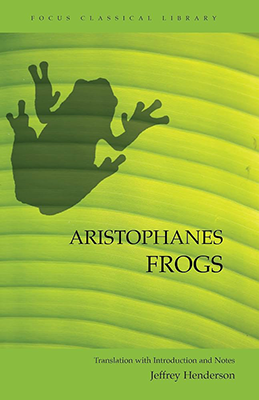
Aristophanes. Frogs. Trans. Jeffrey Henderson. Newburyport, Mass.: Hackett/Focus Publishing, 2008. ISBN 978-1-58510-308-9. (Available via bookstore.)
Study Guide Proper
Basic Facts
Playwright. Aristophanes, Athenian, ca. 455-ca. 385 BCE.
Genre. Old Comedy (see below).
Festival. Lenaea (January Dionysian festival).
Time. The "now" of its production (405 BCE).
Setting. First, the street outside Heracles' door. Then the underworld, i.e., land of the dead.
Reception. The play won first prize. Second went to Phynichus for Muses; third to Plato the comic poet (not the philosopher) for Cleophon. That will have been out of five playwrights competing. "The play was so admired for the advice given in its parabasis [in the Henderson translation, lines 674-737 = pp. 62-64] that it was produced for a second time" — that's from an ancient descriptive note.
Situation. Euripides and Sophocles have just died the previous year (406 BCE), Aeschylus has been gone since 456. Athens is without its greatest playwrights. At the same time, Athens is in danger of defeat and possible destruction at Spartan hands. (Remember, we're at the tail end of the Peloponnesian War, 431-404 BCE.) Dionysus, god of theater, is concerned; indeed, he has a yearning for Euripides as big as Heracles' for minestrone soup. So, disguised as Heracles (Heracles has already travelled to the land of the dead, specifically, to capture the three-headed dog, Cerberus), Dionysus along with his slave, Xanthias ("Blondie"), head on down to the underworld to retrieve Euripides to put things right. (They've stopped off at the house of Heracles — he's a veteran Hades visitor — to pick up some gear from the hero and some tips.) But when Xanthias and Dionysus arrive, they find that the poet of the Bacchae has seized the Throne of Tragedy away from its previous holder, Aeschylus. So a contest ensues: Whose tragedies are better? Who has more to offer Athens? Who'll go back with Dionysus to the world above?
Characters.
- Chorus of Frogs
- Chorus of Initiates (Demeter and Dionysus worshipers)
- The god Dionysus (in this play known also as Iacchus)
- His slave Xanthias ("Blondie")
- The hero Heracles
- Pluto (king of the dead)
- Charon (ferryman who transports the dead to Hades)
- Aeacus (doorman of the dead)
- Aeschylus
- Euripides
- Assorted other speaking and non-speaking parts (see text)
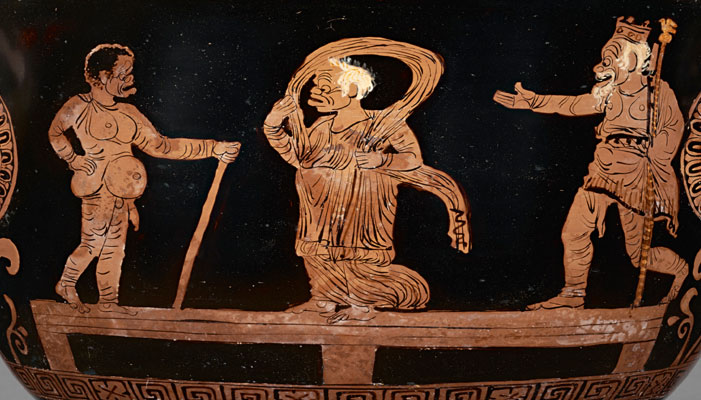
Genre: Old Comedy
We call the genre Old Comedy; that's to distinguish it (naturally!) from Middle and New Comedy. Greek comedy (kōmōidia, "kōmos song"), like tragedy and satyr drama, has its origins in impersonation and role-play associated with Dionysian cult and revelry. Old Greek Comedy is generally dated from the year 486 (the year that comedy was first entered into competition at the Greater Dionysia) till about 400 BCE. It was a purely Athenian genre.
The Old Comic playwright whose plays we know best is Aristophanes, and I'll talk about his plays here.
Like contemporary tragedy and satyr drama, Old Comedy features a chorus and solo actors. The Old-Comic chorus plays a key role: big, splashy production numbers feqautring song, dance, fancy costumes, and so on. Absurd personifications and anthropomorphisms abound in Old Comedy: choruses of wasps (Wasps), of clouds (Clouds), of birds (Birds), of towns (Eupolis' Towns) — you get the idea. Also, Old Comedy didn't hold itself to the same three-actor limit that tragedy and satyr drama did: big casts.
Aristophanes' comedies feature a number of elements also found in tragedy: a prologue to set the story up, a choral entry song, actor-actor dialogue, imitation of tragic style and song (paratragedy), etc. But the resemblances to tragedy more or less end there. One element distinctive to Old Comedy is the parabasis, a complex choral number where the chorus is the star. Aristophanes in his parabases (plural of parabasis) often lands barbed comments on fellow Athenians: politicians, fellow playwrights, anyone. In the parabasis of Frogs, Aristophanes delivers political advice. Aristophanes' parabases also see the chorus openly demand that the judges award their playwright the prize, often with tongue-in-cheek bribes. For Aristophanes, the comic chorus is a bully pulpit.
The plots of Aristophanes' comedies are often quite complex and somewhat chaotic. One plot line can get side-tracked into another. In Frogs, Dionysus starts out wanting to rescue Euripides from Hades, but ends up judging a contesxt between Euripides and Aeschylus.
Always, the situations in Aristophanes resonate with contemporary Athenian life, often with real-life characters. Except that comedy will take that situation, say, Athens lack of good tragic poets, and introduce absurd, sometimes supernatural elements, for instance, if we lack good poets in the land of the living, lets go get one from the land of the dead. In its absurd and unreal moments, Arsitophanic comedy can get very mythological.
As usual for Aristophanes, there is lots of indecent horsing around, lots of verbal abuse of living persons, lots of satire. But do all the poop, fart, sex, and hitting jokes mean that Frogs can't also possess serious content? You'll notice I'm trying get you to consider at the least the possibility that it might. Even the extremely silly frog chorus ("Brekekekex koax koax") has something serious to say. If you consider the whole in relation to what's at stake (politically, militarily, artistically), peremptory dismissal of the play's seriousness becomes less of an option.
Please attend closely to any and all political themes you might find in Frogs. One of them has to do with the recall of the exiles from 411 BCE. In that year, Athens experienced a brief but traumatizing episode of oligarchic (antidemocratic) "rule by the few." The leaders of that are in exile. With war-torn Athens as desperate as it is now, isn't it maybe time to bring them back?
Allusions, Topical References
For the most part, very few of those allusions and topical references are crucial for understanding the play. You can basically read them and say to yourself, "OK, back in the day, I would have chuckled at all that, had I known what they were talking about."
Please check out the clickable notes in the Kindle edition, or the footnotes in the print edition, of Henderson's Focus translation. Those notes are excellent.
Certain things will, though, help if you come to the text armed in advance with knowledge of them:
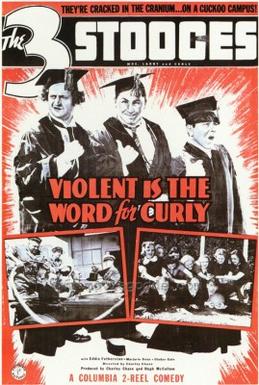
- Dionysus and Xanthias. The god of wine, theater, etc., and his slave. This is the Dionysus often seen on vase paintings of the period: delicate and dressed in gender-ambiguous garments. Xanthias' name refers to his red/blond-colored (ancient Greeks mostly didn't distinguish) hair. It's likely he's a captive brought from the north: possibly Thracian (north coast of the Aegean Sea), possibly a Celt, possibly a German or Slav. Slavery was taken for granted in the ancient Greek world; slave abuse could be treated as something to laugh at. The trading of places by Dionysus and Xanthias — Dionysus and disguised as the hero Heracles, but Di and Xan trade off costumes — is a source of laughs. Ditto the assault-and-battery business — think Three Stooges
- Frog chorus. The chorus of frogs (to get to the underworld, you have to cross a marshy lake) sings; I guess that "Brekekekex koax koax" is "rivet rivet" in ancient Greek
- Chorus of initiates, invocation of goddess Demeter and her daughter, etc. The play evokes initiation into the the religious mysteries of Demeter, goddess of the grain. Think of mystery religion like a secret society with initiation rituals, secret knowledge, and all that goes with that, a bit like frat-sorority initiation with Da Vinci Code overtones. Often, mystery religion concerned itself with the immortality of the soul. Demeter's connection is the cyclical nature of the seasons and of life: The grain dies in autumn-winter; it is reborn in spring-summer. Dionysus, who had his own mysteries (check out Euripides' Bacchae) was also associated with Demeter's mysteries under the name Iacchus. Here, tragedy is itself treated as if it were a vitally important initiatory business, a salvation for the city
- Democratic politicians. Remember, Athens at this time is a democracy. You'll see several names of politicians; for our purposes, none matter. Aristophanes does, though, typically poke fun at male politicians by claiming they are sexually passive, greedy, etc. etc.
- Other dramatists, especially comic poets like Aristophanes. Our playwright mentions several writers of drama. There are the three well-known (even today!) tragic poets: Aeschylus, Sophocles, and Euripides. Aristophanes also mentions Agathon as a good tragedian. In our play's present, Agathon is dead. Today, we have only scraps of his tragedies. Another tragic poet whose plays do not survive entire is Iophon. Aristophanes mentions rival comic poets: Phrynichus (who has a comedy entered into the same comic contest, won second place) and Cratinus (formerly a rival of Ar.'s, now deceased)
- Recent events. This is the tail end of the Peloponnesian War pitting Athens and allies against Sparta and allies. Athens is losing, though the city has recently won a naval battle at Arginusae (in the Aegean Sea), in 406 BCE, the year before Frogs. For the Athenians, the loss of life and ships was considerable. Also, the Athenian commanders at Arginusae, because they had failed to rescue sailors shipwrecked in the battle (they were prevented by a storm), were executed. Then there is the fact that Euripides, Sophocles, and Agathon are all recently dead, and Aeschylus is long dead. Tragedy, like Athens, is in decline. Can bringing back one of the greats from the past restore tragedy and save Athens?
- Alcibiades. Alcibiades isn't a character in the play, but he figures prominently in the final section of the final debate. For the win, Dionysus in Frogs asks Euripides and Aeschylus to express what each thinks about this highly controversial and divisive figure: whether Athens should once again go to him to seek his help. Alcibiades, aristocrat, orator, and brilliant strategist, was also vain, violent, selfish, and unreliable. The Athenian people alternated between, on the one hand, being smitten with his personal beauty and charismatic leadership, on the other hand, heaping blame upon him, and not without cause, for all manner of woe that befell the city. He betrayed Athens more than once, and he betrayed Athens' enemies, too. At this stage in the game, with the war with Sparta going terribly for the Athenians, recalling Alcibiades from exile would have appeared a last-ditch effort to wrest victory from the jaws of defeat