Text Access
Euripides. 10 Plays. Trans. Paul Roche. New York: Signet Classic, 1998. (Available via bookstore or Kindle)
Guiding Question
In Tragedy, the Greeks, and Us, Simon Critchley writes, "Tragedy requires some degree of complicity on our part in the disaster that destroys us" (p. 12). He also writes, "But we are tyrants too" (p. 15), that is, all of us, like Oedipus in Sophocles' OTK, are liable to ignore, and, in a sense, shamelessly, our complicity in our fate. So,
Are there characters in Euripides' Hippolytus who are somehow complicit in the tragic events that overtake them? And if there are, does that diminish the pity we feel for them? (As if to say, "Serves them right!") Finally, do we see ourselves in those characters in any way? Do we identify with this idea of tragic complicity?
Please keep in mind that this is an exercise in critical thinking. Put simply, we are trying to test Critchley's ideas. That involves reading and thinking: reading the play, reading the chapter from Critchley's book, thinking about both. No two ways about it — thanks!!
Introduction to the Play
- Produced 428 BCE
- Festival: Greater Dionysia
- Placed first. (One of four occasions when plays of Euripides won first prize. The other three plays in the tetralogy are unknown)
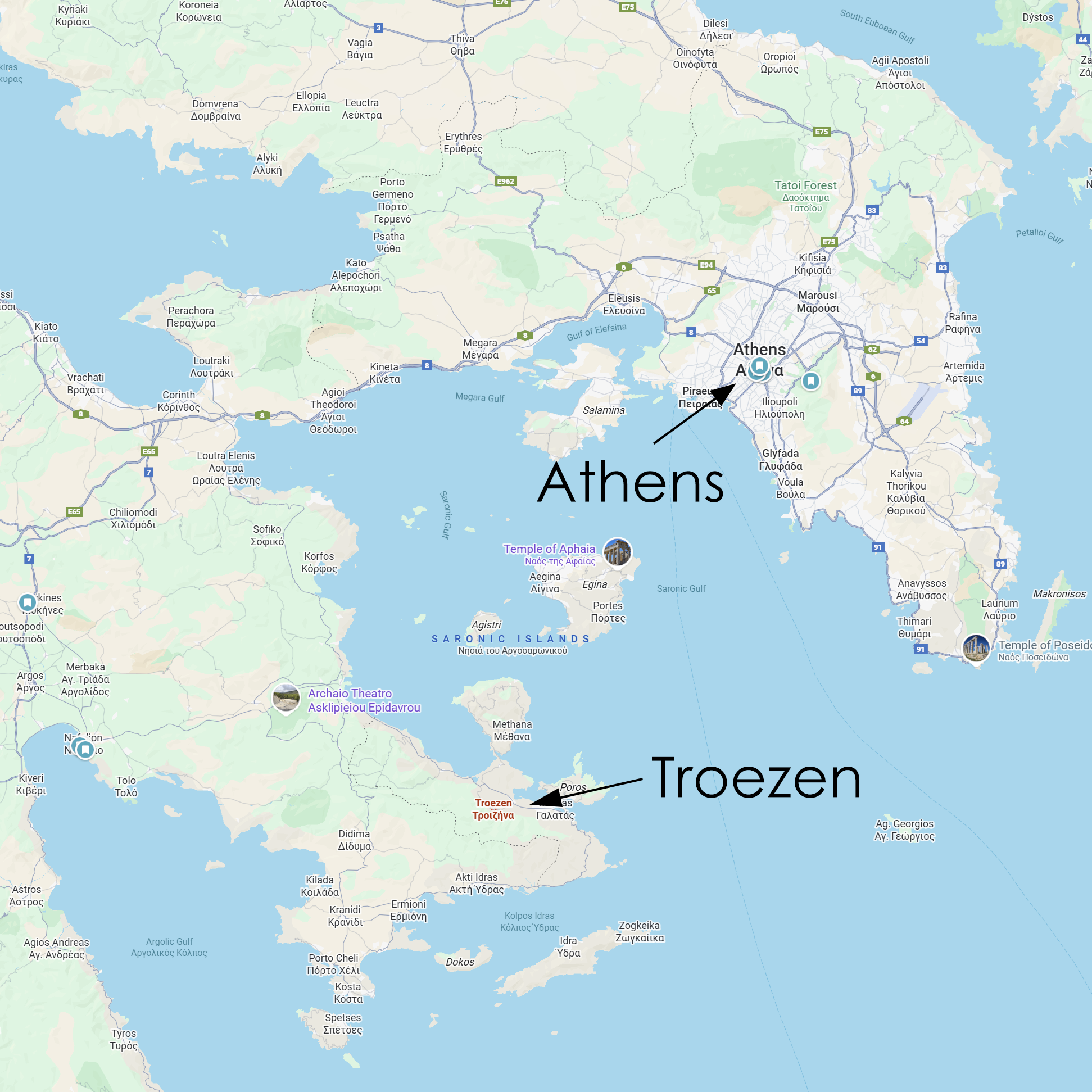
- Setting: Troezen (TREE-zen), on the northeast coast of the Peloponnese peninsula
- Plot. The title character is Hippolytus, whose mother was the queen of the Amazons, non-Greek warrior women from the Black Sea region. Hippolytus is a devotee of the virgin goddess of the hunt, Artemis; he himself spends his days hunting and is a virgin. Hippolytus' disinterest in sex angers Aphrodite, who has caused Hippolytus' stepmother — Phaedra, wife of Theseus, king of Athens, and Hippolytus' father — to fall in love with the lad. That will prove the destruction of Hippolytus, but Phaedra will also have to die. Theseus, seeking purification after killing kinsmen of his, has fled the city for Troezen, where Hippolytus grew up and still lives. Phaedra, who first beheld Hippolytus during sacred rituals near Athens (at the Eleusinian mysteries), accompanies her husband. Phaedra's nurse tells Hippolytus of the queen's love, but Hippolytus does not requite that love. Phaedra commits suicide for shame. Theseus, who has been away visiting an oracles (we're not told which), comes back to find his wife dead and a suicide note accusing Hippolytus of raping her. Theseus, enraged, sends a sea monster to kill him; Hippolytus' horses are spooked and Hippolytus dies in a chariot wreck. The dying Hippolytus is brought on stage with Theseus; joining them is the goddess Artemis (deus ex machina), who explains what actually happened, and that Hippolytus will receive religious worship after his death. She bids farewell to Hippolytus, who then dies
- Characters:
- Aphrodite, goddess of love
- Hippolytus, virgin son of Theseus and devotee of the hunt
- Servant (the "Old Retainer")
- Phaedra's nurse
- Servant woman
- Theseus, king of Athens, father of Hippolytus, husband of Phaedra
- Messenger
- Artemis
- Chorus of Troezenian women
Additional Notes
It was highly unusual for playwrights in classical Athens to compose and produce two plays on the same story, but that's what Euripides did. The first Hippolytus differs from this later one: Phaedra, in love with Hippolytus, tries to seduce him but is rebuffed. Angry, and to defend against accusations against herself, Phaedra tells Theseus that Hippolytus tried to tape her. Theseus sicks the sea monster on his son. This first Hippolytus did not do well in competition. Its text did not survive.
One reason we're reading the surviving Hippolytus is that centuries later (mid 100s CE), the Roman playwright Seneca composed a tragedy based on the same myth. I've assigned Seneca's Phaedra for later in the semester; that will give us a chance to compare and contrast Greek and Roman treatments of the story.
Text Notes
Erechtheus’ scion = Theseus.
Limna, a marsh near Troezen.
Enetian = Venetian.
"PHAEDRA: It begins with my poor mother. How freakish was her love!" Phaedra's mother fell in love with a bull and gave birth to the Minotaur.
"NURSE: Very well then, if you are determined not to sin." Sin here is hamartia.
"There was a girl in Oechalia A filly unbroken by man: Unbedded, unbridled, unfettered, Who was driven by Love, Aphrodite, And fled like a flame or a Bacchant Far from her home; and was given As a bride to Alcmena’s son In a wedding most gory." Heracles, Alcmena's sacked Oechalia and killed the father and brother and of Iole, whom he took to his bed. That story illustrates the madness of eros.
"ARTEMIS: [chanting] I call on you, noble son of Aegeus." Artemis addresses Theseus.