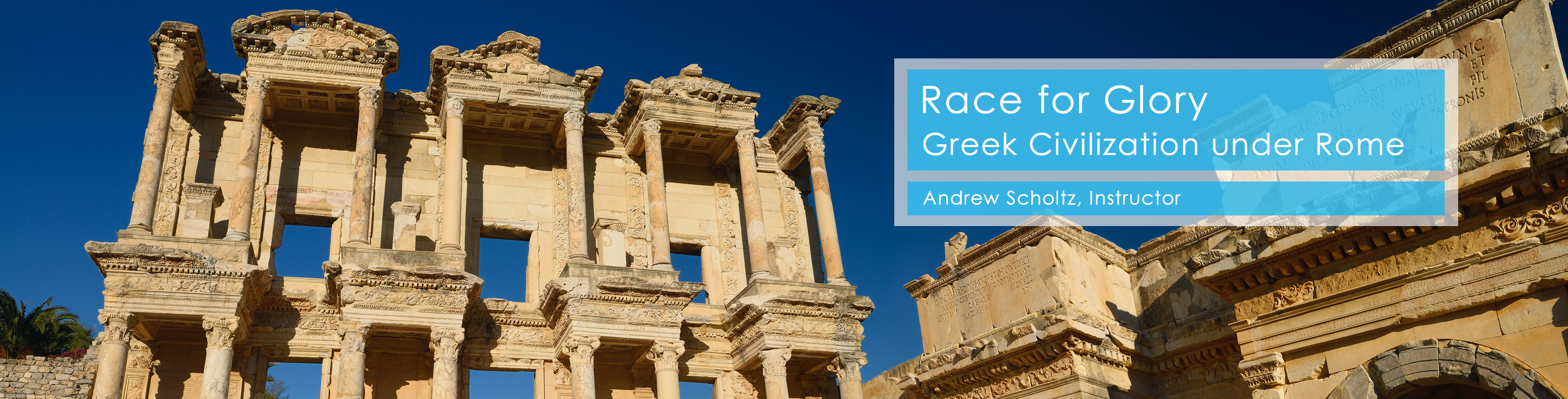
In a poem from 1845, Edgar Allan Poe longs for "the glory that was Greece, / And the grandeur that was Rome." But what was Greek glory under Rome? As we shall see, it was in many ways a re-performance of past greatness in the face of a challenging present. To be proudly Greek under Roman rule involved a tricky sort of negotiation, both with the ruling power and with fellow Imperial subjects. Indeed, it seems to have fostered a climate of intense rivalry in the Greek-speaking Roman East, whose star orators, athletes, and others competed on a grand scale.
Hence competition as a theme central to the course: celebrity sophists battling one another for prestige; cities battling for Imperial favor; ordinary folks seeking to get ahead of, or not to be left behind by, other ordinary folks. There were prizes to be won, but dangers, too, especially those posed by envious rivals. In the end, such concerns generated much cultural production, but they reveal as well fault-lines within ideologies shaping the creation of materials we shall study.
Course Topics
For the time and place to be studied (very broadly, Greek-speaking lands under Roman rule, ca. 1 to ca. 300 ce), topics we shall explore include:
- Athletic training and competition, culture generally
- Emotions associated with competition
- Euergetism, i.e., the race for prestige by wealthy sponsors of public works
- Reception and transformation of the past
- How to keep the classical Greek past alive and fresh, how to imitate or surpass it, in the Roman-dominated present
- How to evoke the Greek past as a way to assert identity
- Rhetorical culture, that is, the teaching, performance, and practical use of public speaking
- Issues of gender and sexuality in relation to status and prestige
- Literary treatments of the experiences of sub-elites
Readings, Other Objects of Study
Those topics we shall explore through physical and written evidence: architecture, art, writings, inscriptions. Texts, mostly in PDF form, include:
- Philostratus
- On Athletic Training
- Life of Apollonius of Tyana
- Lives of the Sophists
- Lucian
- Death of Peregrinus
- The True Story (or, A Trip to the Moon)
- Select declamations
- Polemon Physiognomy
- Modern studies