Assignment Details, SWA Prompt
This time around, SWA entries are to get you acquainted with the geographical and historical background to the material we're dealing with. This isn't a history or geography course, but there is basic groundwork we need to lay.
This assignment's SWA entries are also supposed to help you see how widely throughout the Roman Empire, Greek culture, including its sophistic-literary and athletic aspects, had spread.
Thus for your SWA entries, I want you:
- To view and to study three maps/web pages with maps:
- This up-to-date Google map centered on regions formerly part of the Roman Empire
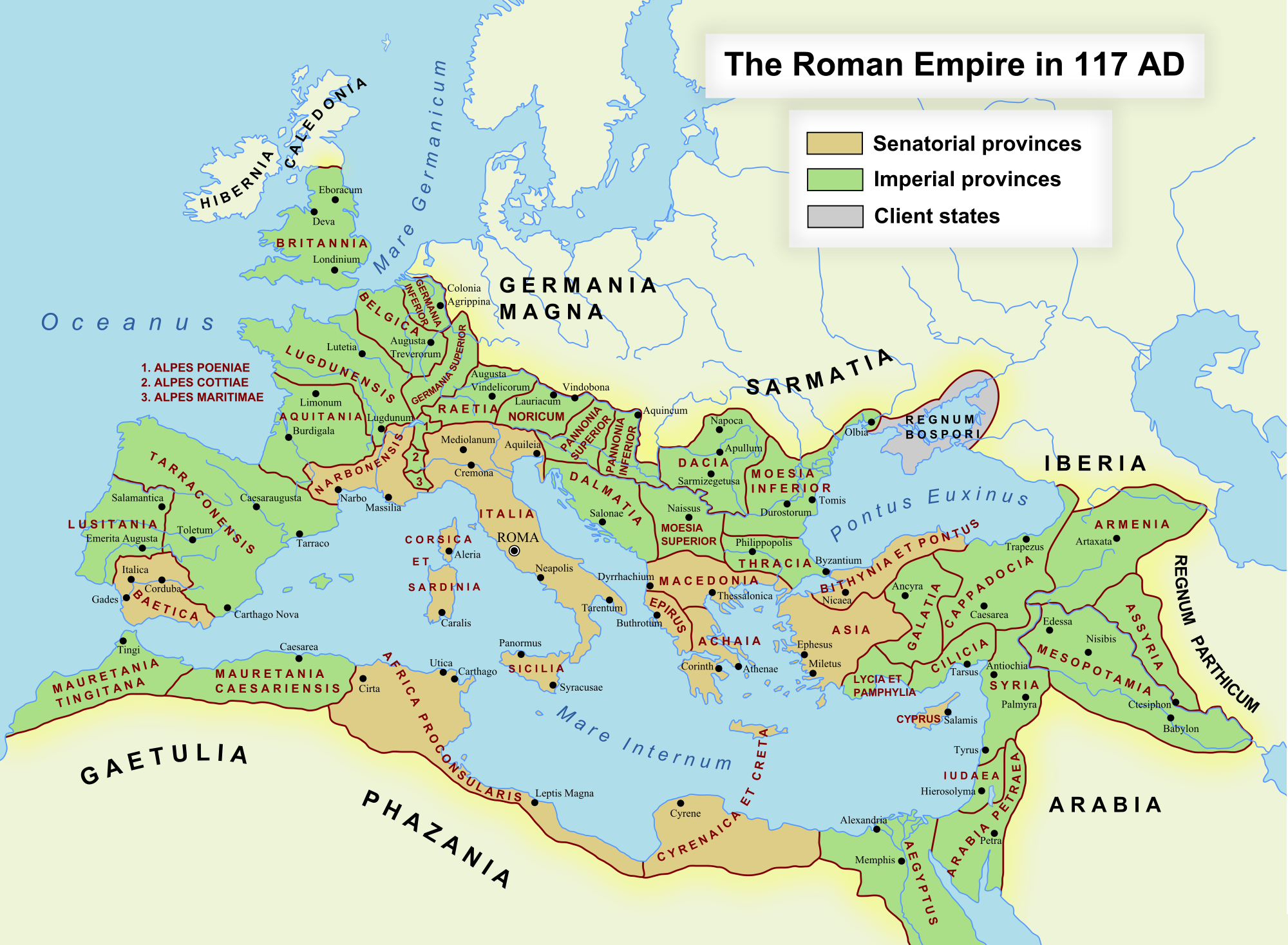
- Andrei Nacu's resizable "The Roman Empire in 117 AD"
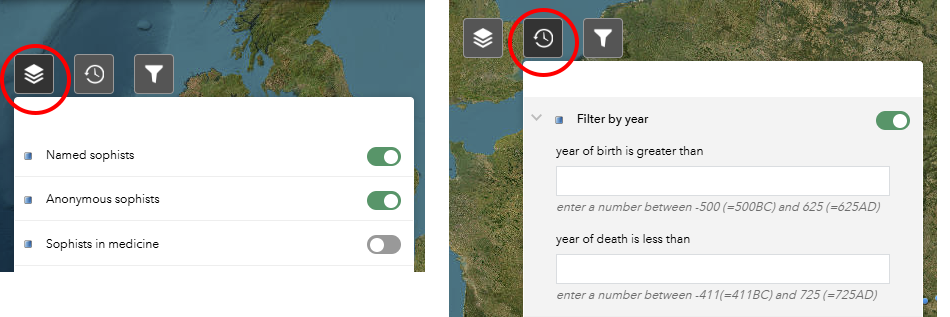
- Sinja Küpper's "story Map Sophists," aka "Interactive Map," on her "Movement in the Second Sophistic" page. ("Second sophistic" means the culture of Greek oratory under the Roman Empire, ca. 50 CE-ca. 250)
- To go to Küpper's "Movement in the Second Sophistic" page. There, I want you to play with the interactive map and its filters. With the sophist filter (piled papers icon), select for named and anonymous sophists (not for "sophists in medicine"). With the "Filter by year" filter turned on, play with the "year of birth is greater than/year of death is less than" boxes. (All dates CE. Ignore the funnel-shaped filter.) Create multiple visualizations allowing you to track fluctuation in numbers of sophists over the course of the 1st through 4th centuries BCE. Using Nacu's "The Roman Empire in 117 AD," try to see which provinces show the greatest concentration of sophists for those centuries. Enter your findings into the text box. (Play around with it; this isn't the most scientific way of conducting statistical research, but it'll do. You'll see that you can zoom in and out on the map; also, move it around with your mouse.)
- To read and study "Roman Empire" @ Encyclopaedia Britannica. You can stop reading just before the "Legacy of Rome" heading. Put together a really concise time-line of events that seem pertinent to our material: year, event. What matters most? Write that into your SWA prompt.
Aim of "Overview" Class. . .
Here, we're especially interested in the relationship between Imperial Rome and the Greek cultural tradition: how, under Roman domination, Greek-speakers in the Roman East drew pride and a keen sense of identity from that tradition, and how Romans made Greek culture a part of their own heritage.
That clearly involved some major developments. . . .
- For the Roman Republic (509-27 BCE) and early Empire (27 BCE to about 100 CE), we learn of Romans' ambivalence regarding Greece: Greek language and literature as necessary, alongside Latin, for elite Romans to learn, but Greek-speaking peoples of the time as not always deserving the respect of the Romans who had conquered them
- From about 200 BCE, but especially from the time of Augustus (r. 27 BCE-14 CE) onward, a growing embrace by Romans of Greek culture as "ours" and, eventually, of Greek-speakers as "us"
More. . . .
- As the years past and as Roman rule solidified in the eastern Mediterranean, features of Roman culture (e.g., gladiatorial combats, Roman-style baths) and politics (Roman citizenship; in 212 CE, the emperor Caracalla declared all free persons in the Roman Empire to be citizens of Rome) took hold in Greek-speaking lands and elsewhere. Increasingly, non-Italians, including Greek-speakers in the East, held important positions in Roman government, including those of senator, consul, and emperor
- At the same time, Greek writers under the Empire show a reawakened interest in Greek heritage
- Roman emperors played a role in all this. . .
- The Roman emperor Nero (r. 54-68) was a lover of all things Greek, especially Greek poetry and music. In 66 CE, he traveled to Greece to tour around and to participate in athletic and poetic festivals
- A crucial player in fostering a sense of Pan-Mediterranean, Greco-Roman identity was the emperor Hadrian (r. 117-138 CE). Devoted to Greek rhetorical culture and to Greek culture generally, Hadrian oversaw the completion of the temple of Olympian Zeus at Athens and built a library there with a speech-recitation auditorium
- His successor, Antoninus Pius (r. 138-161), established a "chair" (a professorship) in Greek rhetoric at Athens
- The emperor Marcus Aurelius (r. 161-180 CE) was also a devotee of rhetoric, both Greek and Latin. More than that, he was a Stoic philosopher and composed his Meditations in Greek
- Julia Domna (Augusta 211-217 CE), the Syrian wife of the African emperor Septimius Severus (se-vér-us, r. 193-211), the mother of the emperor Caracalla (r. 198-217 CE), and a patron of Philostratus the Greek sophist (170-ca. 250 CE), was deeply interested in Greek literature and philosophy
Much of the above goes to the heart of what this class is about, and it will help to get some historical, geographical, and prosopographical background.
- Prosopography is the study of historical personages, with a focus on connections — family connections; political, social, professional ties; etc. — and shared characteristics of historical actors. Prosopography has been used by historians of the ancient Mediterranean to build a picture of various aspects of Greek and Roman society and politics.