Assignment
- Read this Study Guide carefully and in full (this is important)
- Read select passages, linked to below, from Philostratus' Lives of the Sophists
- Enter your SWA in response to the following SWA prompt. . .
SWA Prompt (one with a strongly critical-thinking component)
Does it make sense to speak of the second sophistic (1st-3rd cent. CE) as a broadly cultural phenomenon, or should we limit our understanding of the second sophistic to something more narrowly rhetorical?
Philostratus, who coined the phrase "second sophistic," understands it as a basically rhetorical moment. Several modern scholars, including Simon Swain (whose chapter on the Greek Novel we've read), find it fruitful to think with the idea of the second sophistic as a cultural moment.* What say you? Don't worry that we're still just beginning our journey; we should always have our-critical thinking caps on.
* Compare Anderson, Graham. The Second Sophistic: A Cultural Phenomenon in the Roman Empire. London and New York: Routledge, 1993.
Text
Miles, Graeme, and Han Baltussen. Philostratus. Lives of the sophists. Eunapius. Lives of Sophists and Philosophers. Cambridge, Mass.: Harvard University Press, 2023.
Assigned Page Ranges with Links (highlighted) plus Notes
Preface, introductory remarks. pp. 33-35. Philostratus dedicates his book to one of three Gordians, emperors from 238 to 244; it is not known which one. Note the distinction Philostratus makes between philosophers who enjoy a reputation as sophists and those who are sophists properly speaking. In readings, Favorinus exemplifies the former, Scopelian and Polemon, the latter.
Then, in a part of the book that I'm not assigning, Philostratus (a) draws a distinction between the "ancient" (arkhaia) and the "second" (deutera) sophistic; and (b) develops the distinction, mentioned just above between philosopher-sophists and sophists pure and simple. Philostratus maintains that the "ancient" sophistic of the 400s and 300s — e.g., Protagoras, Antiphon, Gorgias (I have a page on them) — was "rhetoric doing philosophy" (p. 35). That pattern continued into the Imperial period with Dio of Prusa and (see just below) Favorinus.
For Philostratus, the "second" sophistic began with Aeschines son of Atrometus in the later 300s BCE (pp. 91-97). What set Aeschines apart was that he both taught and practiced the art of improvised speechifying on varied themes, a performance art termed "declamation," or in Greek, meletē. For Protagoras, this last is the very definition of sophistic practice. Aeschines is, then, the first of Philostratus' "second sophists." In Philostratus' book, the next such sophist, namely, Nicetes of Smyrna (in western Anatolia), doesn't come along until the first century CE. Modern use of "second sophistic" has it starting in the first century CE.
Favorinus of Arelate (present-day Arles, France, ca. 85-155 CE), pp. 55-63, one of Philostratus' philosopher-sophists. Some (not many) of his works are preserved. As high priest (of his home city? p. 57), he would have been expected to pay for public entertainments: gladiators and such. Dio (p. 57): Dio of Prusa, another philosopher-sophist. "It would have been better for Socrates" (p. 57): Socrates was put to death by the Athenians in 399 BCE. Pyrrho (p. 61): an important Sceptic philosopher. Pages 59-61, where Philostratus relates the rivalry between Favorinus and Polemon, is important on the dangers of ambition, what our translation calls "love of glory," in Greek, philotimia. The phrase "spirit of rivalry" translates to philotimon, which means literally "the element of ambition." In Philostratus, philotimia and to philotimon are virtually the same as zēlos-"emulousness." Consuls (p. 59) were officials outranked only by emperors, though under the Empire, the office became largely honorary and a "stepping-stone" (Brill's New Pauly) on the way to a lucrative governorship.
- Favorinus probably wasn't a hermaphrodite. Rather, he may have been anorchid. Noteworthy are the facts that (a) Favorinus isn't ethnically Greek (he is "from among the Gauls of the west"), and (b) was equally at home in Greek and Latin, though he preferred Greek. The account of Favorinus and his pal, Herodes Atticus, making fun of the slave Autolecythus is extremely unattractive, indeed, racist. Sophists that they are, Favorinus and Herodes taunt Autolecythus over the latter's poor Greek.
Scopelian of Clazomenae in western Anatolia (active ca. 80-115 CE), pp. 107 (middle)-125. "Dithyrambic" (p. 107): impassioned, poetic. "For humanity is a thing envious by nature" (p. 107): "envious," epiphthonon; from phthonos, "envy." "Half-married" (p. 113): i.e., the step-mother was technically a concubine, not a wife. "For this reason Scopelian said that while Anaxagoras' property became a sheep pasture, his own was a slave pasture" (p. 117) — Anaxagoras, a philosopher from centuries earler, was exiled and forced to give up his land, which became (according to Scopelian) a sheep pasture. Scopelian's property, when it passed to to the ex-slave Cytherus, became a slave's. "Among the sophists he especially kept company with Gorgias of Leontini, and of the orators those with a brilliant tone" — Philostratus means that Scopelian imitated those writers, dead but classics. "He excelled in language adorned with formal figures and in ambiguity..." (p. 119). "Ambiguity" refers to "figured discourse," about which more later. "Herms" (p. 123): at this point in time, a style of portrait.
Polemon (Polemo in the Loeb text) of Laodicea (90-146 CE), pp. 145-175. Polemon came from a family of wealth and distinction. Note Polemon's full name in Latin: Marcus Antonius Polemo. The Marcus Antonius bit is the Roman part of the name. It derives from the bestowal of Roman citizenship upon an ancestor by the Roman general Mark Antony (83-30 BCE). As for Polemo, that is his (lightly Latinized) Greek name. When a foreigner was made a Roman citizen, that person took the praenomen (here, Marcus) and the nomen, or clan-name (here, Antonius), of the Roman sponsor. That Roman portion of the name was, along with Roman citizenship, passed on to descendants. We're going to see a lot of that in this course: Greeks and other provincials with Roman citizenship, and the most prominent among them climbing the ladder of Roman politics. Julia Domna and her imperial kin, descended from Syrian kings, are a conspicuous example of the phenomenon. Polemon was born in Laodicea on the Lycus, in Anatolia, but lived in, was citizen of, and served the city of Smyrna, on the Aegean coast of Anatolia. We have two speeches surviving by Polemon, plus a treatise on physiognomy, the art of knowing the soul from bodily signs. His rivalry with Favorinus is of great interest to us.
"The Olympics founded by [the Roman emperor] Hadrian" (p. 145): in Smyrna. The original Olympic games were held in Olympia, Greece. Under the Empire, Olympic games sprang up all over. "to go on board the sacred trireme" (p. 145): a ceremonial parade float in the form of a war ship. "both continents" (p. 147: Asian and Europe. "corn markets" (p. 147): wheat markets. "the Museum" (p. 149): part of the Library of Alexandria. "Antoninus" (p. 153): Antoninus Pius, governor of Asia (Anatolia) 135-136, emperor 138-161. His adoptive father was Hadrian. "Pergamum" (p. 155): a hospital city in Anatolia. "Herodes the Athenian" (p. 159): Herodes Atticus (see above). "The theatrical effects of the man" (p. 159). These are the actorly aspects of giving a speech: vocal delivery, gestures, facial expressions, physical deportment. "Demosthenes swears that he did not take the bribe of fifty talents" etc. (p. 161): these declamatory themes (hupotheseis) have the orator impersonating a figure from history and (re)enacting a speech given by that figure. "And Polemo used to say that one should bring out prose works by the armload, but those of the poets by the wagonload" (p. 165): i.e., that the aspiring orator needs to study classic literature assiduously and extensively. "an Ionian youth" (p. 167): Ionia was a region located on the western coast of Anatolia. "solecism" (p. 171): a grammatical or similar mistake.
Introduction to Readings
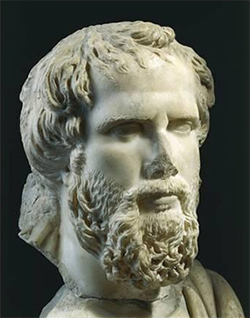
This assignment concerns Greek rhetoric and rhetorical culture during the period of the so-called second sophistic. I say "so-called" because the term itself is somewhat contentious. It has even been denied that the period of the second sophistic, first through third centuries CE, really saw the rise of anything new, rhetorically. Rohde, the first scholar since antiquity to adopt the term "second sophistic," understood it as the last, faint glimmer of ancient Greek literature in decline. More recently, scholars have treated it as something much more positive. Indeed, Graham Anderson justifies use of the term "second sophistic" in relation to what he sees as a Greek renaissance.
At the same time, the very term "sophist" (sophistēs) could carry both positive and pejorative meanings. As a put-down, it meant, and often still does mean, someone dealing in verbal and logical flimflam: lawyers, politicians, dodgy intellectuals. Yet under the Empire, it was also used to honor rhetoricians whose services deserved special recognition and reward.
Second Sophistic
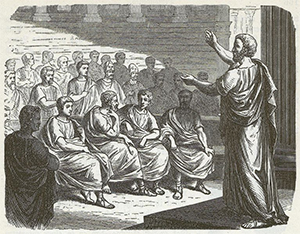
Here, I quote Brill's New Pauly for its definition of the term "second sophistic":
. . . often used by modern scholarship, particularly for the Greek culture (esp. literary culture) during the Roman Empire between AD 60 and AD 230 when 'Sophistic declamation' (μελέτη/melétē) became one of the most prestigious cultural activities in the Greek world. (Brill's New Pauly s.v. "Second Sophistic")
"Sophist" (sophistēs) is a term whose use dates back to the fifth century BCE and perhaps earlier. According to Herodotus, it meant a "master of one's craft, adept, expert." In describing the seven sages of Greece, it conveyed the sense of them as "wise, prudent or statesmanlike" (Liddell-Scott-Jones Lexicon) — people, in other words, who possessed sophia, a combination of outstanding excellence and/or wisdom. Yet already in Herodotus, sophia could convey the idea of "cunning" or "trickery," and it is this ambiguity between "wisdom" and "cunning" that seems to attach itself to sophistic as a professional pursuit in the latter half of the fifth century BCE.
Fast forward to ca. 200 CE. By the time Philostratus started writing his Lives of the Sophists, democracy had largely disappeared from the Greek-speaking world, which Rome now dominated.* After years of havoc wreaked by Rome's conquest of Greece and the eastern Mediterranean (the destruction of Corinth in 146 BCE, the violent siege and sack of Athens by Sulla in 86 BCE, other disasters), oligarchy, rule by the wealthy few, reigned supreme in most Greek-speaking cities, though the term "democracy" continued to be used, sometimes even with a degree of accuracy.
* Keep in mind that the Greek-speaking world at the time included lands and cities extending from southern France to southern Italy, and from there to Greece, Egypt, the middle East, and modern-day Turkey and Syria.
By the time of the early Empire (27 BCE-117 CE), the pax romana, that is, the peace and stability brought about by Roman rule, made possible a revival of economy and culture in Greek-speaking cities. Along with that came renewed interest in Greek identity and in Greek rhetoric as an expression of that identity. Despite the reality of Roman rule, rhetoric continued to flourish. It still had a place in public debates (Greek cities remained largely, not entirely, self-ruling) and in court-room pleading. But rhetoric under Rome found a special home in display oratory: public performances of fictitious speeches, ceremonial oratory praising cities, buildings, emperors. Starting with Nicetes of Smyrna (1st cent. CE), we see a succession of teacher-performers, often highly successful, of just this kind of speechifying.
Philostratus, writing in the years following 200 CE, called these sophists "second sophists," the next stage of sophistic after the first sophistic flowering of the 400s and early 300s BCE. These "second" sophists often were men of means, movers and shakers in their respective cities. Their profession commanded great prestige; sophist was an official designation in more than one city in the Roman East, and could carry with it special privileges. For hefty fees, sophists — not all, but many — taught. The training sophists underwent and the instruction they provided was thought to confer paideia, not just "education" but the kind of learning that befitted a person of breeding. Yet the label "sophist" could still stand for the same bad things — verbal flimflam — that it had centuries earlier.
Imperial sophists didn't just teach; they performed. The sorts of shows they put on might happen in a public theater and before a large audience, this last a mix of well-educated cognoscenti and ordinary folks. Typically, the performance started with a more informal warm-up speech (lalia, "talk"; prolalia, "pre-talk"; dialexis, "discourse," "lecture") on a variety of topics: a description of something (an ekphrasis), praise of the city in which you're speaking and of its people (your audience!), lots of different things. This would be done sitting down. Next would come the main event, a declamation, in Greek, meletē, often improvised and on an audience-suggested theme. For this, the sophist would stand; we're told of one sophist who dramatically leaped to his feat whenever he was about to deliver a declamation.
These declamations (meletai) always involved role-play. Imagine that you are George Washington as a child. You must deliver a speech apologizing for cutting down the cherry tree, but making the case ever so discretely that your frankness and contrition deserve your father's admiration. That's your hupothesis, your theme: now go deliver that speech!
Declamations may have been show pieces, but they always posed as real speeches. As such, they usually took one of two basic forms:
- A legal speech, with the speaker posing as prosecutor or defendant in a courtroom case
- A deliberative, usually political, speech, with the speaker either proposing policy or attacking it
Often, the sophist would give paired speeches, taking both sides, one after the other, in an imaginary dispute. And imaginary these speeches always were, sometimes extremely so. From what we read in Philostratus, the soul of declamation was the creation of believable characters, or ēthopoiia, "characterization." But declamation also offered practice, and demonstrated skill, in zeroing in on the crux of the matter, it's stasis or issue. Stasis theory offers a kind of algorithm for generating arguments well suited to the case one would need to make, given the issue at hand.
We need to keep in mind the educational role of sophistic generally and of declamation in particular. This last wasn't just for superstar orators to perform. It was the crowning stage of the rhetorical education that many elite young (mostly) men undertook from maybe the age of 14 to the age of 18. Sophists therefore taught, and a sophist's collection of declamations could/would serve as, among other things, examples to be studied by their students.
There are important issues of gender and class operating here. Sophistic culture mostly excluded women and girls — mostly, but not entirely. Aufria was an orator from Asia Minor (present day Turkey). In the second century CE, she was honored by the Greek city of Delphi. According to a preserved inscription, she "demonstrated the entire range of her education (her paideia), and delivered many excellent and enjoyable speeches at the assembly of Greeks at the Pythian games" (FD III 4:79; translation adapted from Lefkowitz and Fant, Women's Life in Greece and Rome #92). If there was one such woman orator, there will have been others. Also, the empress Julia Domna was deeply interested in Greek culture and thought. We're told that she spent much time with sophists (including Philostratus) and philosophers, and it is to be expected that she was herself adept in self-expression. We learn that Cleopatra (69-30 BCE), queen of Egypt, was attracted to literature; Philostratus, our informant, means Greek literature (Lives of the Sophists pp. 47).
Still, the aforementioned Philostratus, like other male writers, betrays considerable bias against women generally and female intellectuals in particular (Bowie 2018, Dialogues d'histoire ancienne, Supplement 18). Indeed, most students and practitioners of rhetoric were boys and men of means. Rhetoric was, in fact, often understood as a way to perform masculinity and elite status. Though most students of rhetoric did not go on to become rhētores or sophists, the kind of training offered by rhetoric teachers was thought to open doors to men of ambition.
Which brings us to a somewhat troubling topic, for we need to acknowledge that this kind of education could function as gate-keeping, that is, as a way to limit access to privileges and opportunities intended for male persons of elite status. In our class, as we reflect on how education could in the past, and still can to this day, serve to limit access to opportunity, we're reminded that we should aim to make education a gateway to opportunity.
Finally, sophists did not just teach and perform. They competed for students and for fame. Sophists often referred to what they did as competition, agōn. Sometimes what they did was agōn in the fullest sense of the word. It is believed that the Greek-speaking city of Oinoanda, in modern-day Turkey, sponsored competitions in, among other things, rhetoric. We also learn of prizes for speech writers (logographoi) at the Pythian games at Delphi. (Plutarch Moralia 674e; compare the case of Aufria, above.)
Still, what sophists did as sophists when not teaching mostly wasn't what we'd call formally organized competition but solo performances. Yet they always thought of themselves as engaged in a struggle: against other orators, against critics, against anything that might eclipse their fame. Sophists typically felt the eyes of the world fixed on themselves, their every word and movement subject to the merciless evaluation of rivals and a public ready and willing to take them down for any misstep or slip of the tongue. That included the language that they spoke and wrote in. Sophists of the Imperial age typically specialized in a revived form of Attic Greek speech from centuries earlier (the Greek spoken in Athens, 400s and 300s BCE). Mastery of Attic was therefore part of their toolkit, whereas misuse of Attic could sabotage a career. Lucian composed an entire invective (the Pseudologista, or "Fake Word Expert") attacking a critic for attacking Lucian's alleged misuse of a word.
Philostratus: Author Notes
Flavius Philostratus, son of Verus, came, it turns out, from a family of sophists, several named "Philostratus." If scholars are right about which Philostratus was which, our Philostratus was born ca. 170 CE into wealth and held important positions in his native city of Athens. This is probably the "sophist Flavius Philostratus" (Phlabion Philostraton athēnaion sophistēn, IvO 476) whom Athens honored at Olympia by erecting a statue. A son of his and other relatives were Roman senators, a signal honor.
Philostratus, as the inscription notes, was a sophist, and we're told told that around 204, he moved from Athens to Rome, where he continued to teach, just as he had previously. While in Rome, he joined the circle of intellectuals associated with Julia Domna (170–217), wife of the emperor Septimius Sevérus (r. 193-211). (Julia's Syrian ethnicity matters for us because it illustrates the cosmopolitan character of the Roman Empire and of Greco-Roman culture at that time.) Our Philostratus wrote, among other things, these Lives of the Sophists, the Life of Apollonius of Tyana, and other works, including, so we are told, declamations, though none of these last survive.