Reading Access (BU Library login needed)
van Nijf, Onno. 2004. “Athletics and paideia: Festivals and physical education in the world of the Second Sophistic.” In Paideia: The World of the Second Sophistic, edited by Barbara Borg, 203–227. Berlin and New York: Walter de Gruyter.
SWA Prompt
What is van Nijf's basic thesis? (Do not use AI for this!) With which ideas previously encountered in this course does it engage? Do you have any feedback for the author?
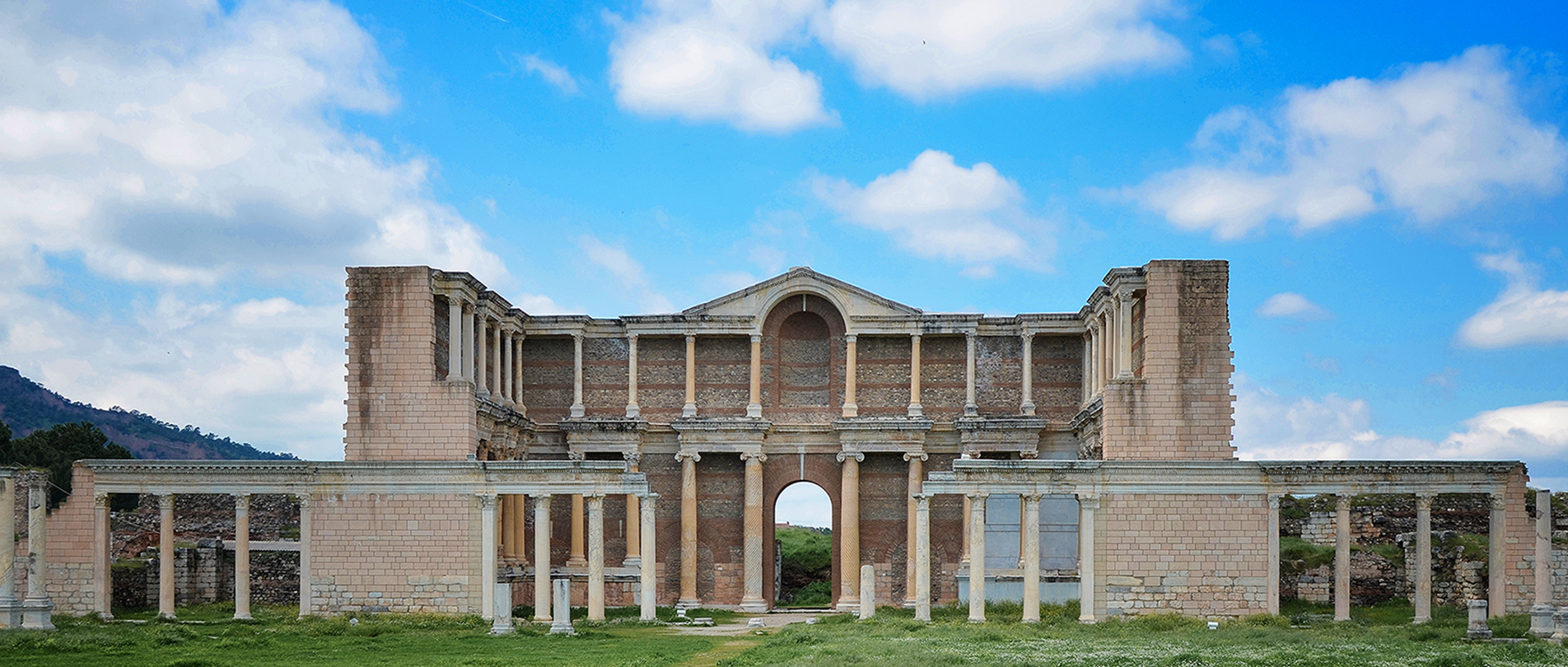
Author, Chapter
Onno van Nijf (fahn NAYF) is Professor of Ancient History at the University of Groningen in the Netherlands. He is considered to be an expert in, among other things, sport in the ancient Greco-Roman world. The assigned chapter comes from a book addressing, as the title of the book indicates, the "World of the Second Sophistic." Perhaps needless to say, van Nijf's chapter, like the book as a whole, is very relevant to our course.
I'll let you read and process the contents of van Nijf's chapter on your own. Here, I'm supplying notes designed to help with geographical, archaeological, historical, and linguistic background.
Notes keyed into page numbers. . . .
204-203. Lucius Pilius Euarestus. Poplius Sthenius Fronto, son of Licinnianus. The two honorands featured on each of the two inscriptions. Lucius seems to be a Greek (Euarestus) with names (Lucius Pilius) suggesting Roman citizenship. Poplius' nomenclature contains only Roman elements. The author notes that he descends from an Italian (and thus Roman) family.
203. Oinoanda (also spelled "Oenoanda") was a city in/just outside northern Lycia, in Anatolia.
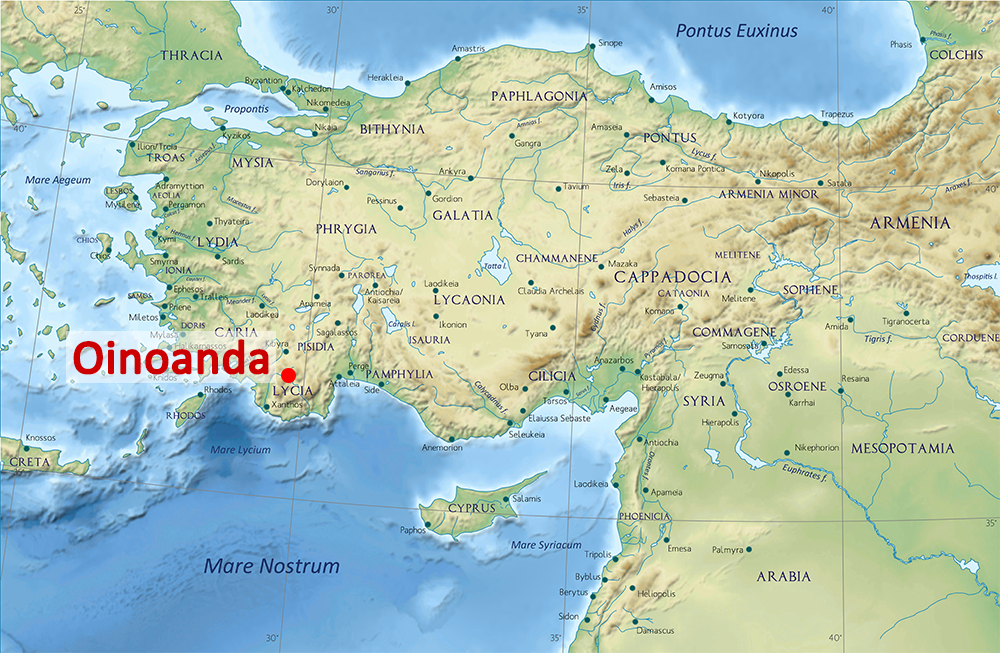
Though originally not Greek, after Alexander the Great's conquests in the late 300s BCE, Oinoanda quickly became Hellenized ("Greekified") linguistically and culturally. Around 84 BCE it was made part of the Roman province of Lycia. Scholars evidently do not consider Oinoanda important except for the fact that preserved there are several extremely important inscriptions, including those discussed in van Nijf's chapter.
203. "agora." Marketplace and city center.
203. "immunity from local liturgies." Liturgies typically are mandatory, one-off contributions by wealthy citizens to fund some project benefiting a given city: a building, an annual festival, etc. (Philanthropic, i.e., voluntary, contributions are similar but not exactly the same.) Euarestus has "immunity" from liturgies — the city is freeing him from having to pay for such stuff.
203. "agonothete." Person running an agōn, a festival featuring competition in sporting and/or other events (poetic, rhetorical, etc.).
203-204. panegyris. That means any festival attended by people from all around.
204. "by decree of the boule and demos." At the bidding of the town council (upper house) and town assembly (lower house). Most Greek cities under the Empire were nominally democracies but actually oligarchies (oligarchy = rule by the elite few).
204. "this fifth themis." This fifth instance of holding the games.
204. "Phoebus, son of Leto." The god Apollo.
204. "Alcides." Herakles (Hercules).
204. "Muse." Goddess of arts, literature, paideia.
204. "So, abating your criticism (mōmos), all those who have dread Envy (phthonos), look upon my statue with emulous (mimēlos, "imitative," virtually the same as zēlōtos, from zēlos) eyes."
204. pankration. Basically, no-holds-barred mixed martial arts, only no eye-poking. Violent and dangerous.
205. gymnasia, plural of gymnasion. Much more than a gym, a gymnasion was a place where male adults exercised and relaxed, and young males studied and trained. They usually had baths attached.
206. periodonikes. Winner of all four of the most ancient and most important Greek athletic festivals: The Olympic, the Pythian, the Isthmian, and the Nemean Games.
207. Palaestrae, singular, palaestra, usually spelled "palestra" in English. Wrestling hall(s).
207. stadion. "Stadium," with a running track typically about one stade long = about 185 meters (607 feet).
208. gymnasiarch. Technically, the official in charge of the gymnasium. In Roman times, the person who paid for the gymnasium and its operation.
210. Gym. Abbreviation for Philostratus' Gymnasticus, a treatise on athletic training.
210. gymnastes. Athletic trainer.
211. "epideictic." Rhetoric concerned with praise or blame, and seeking to show off the orator's skill.
211. pepaideumenos. "Educated," "cultured."
211. "ephebes" ("e-FEEBS"). Under the Empire, an educational institution for male, typically elite youths on the cusp of assuming a civic role; in most cities, ephebes will have been between twelve and eighteen years old. They attended the city's gymnasia for military, athletic, and intellectual (literary, musical, philosophical, rhetorical) training. To quote the Oxford Classical Dictionary on the ephēbeia ("ephebate," that is, institutions governing the training of ephebes; also, ephebes considered as a collective unit), "The post-Classical [= post 300 BCE] ephēbeia was a civic instrument for relaying a basic and, on the whole, surprisingly uniform cultural Hellenism to the rising generation. . . ." (Note that this is not the same as attending a dedicated rhetorical or philosophical school. But ephebes did receive philosophical and rhetorical training.)
212. Philomousos, Philologos as proper names. As an adjective, philomousos means "loving music and the arts"; philologos means "fond of learning and literature, literary" (LSJ).
212. "Perikles, Atalante, or Plato." Respectively, the 400s-BCE leader of the Athenian democracy, a mythological female champion runner, the most important Greek philosopher and prose writer.
213. Termessos, a city in Pisidia, close to Oinoanda.
213. euergesia. Action beneficial to one's city, especially, but not confined to, charitable giving.
214. "epigrams." The word "epigram" can mean a very short poem, even just a single line (in modern usage, especially this), or an inscription, typically on stone (less often in modern usage). An epigram can, of course, be both at once.
216. mousikos agôn. Cultural (musical/literary/rhetorical) contest.
216. "Philhellene." Favorable to everyone/everything Greek.
216. πανήγυρις θυμελική, panēguris thumelikē. In the narrowest sense, a theatrical festival — lots of plays. In context here, a festival featuring athletic and cultural contests.
218. "the traveling synod of Dionysiac artists." Traveling professional theater troupes often referred to themselves as "the artists of Dionysus," Dionysus being the god of theater.
218. "biologos a type of mime." A biologos was a comic player who specialized in representing ordinary people.
220. agonothetai. Plural of agonothetēs, "agonothete" (see above, p. 203).
220. "heavy Greek athletes." I'm guessing that what van Nijf means are wrestlers, boxers, and pancratiasts (as opposed to runners, jumpers, etc.).
220. Mysia. Region in northwest Anatolia.
220. topos. "Commonplace," a conventional and recurring argument, motif, sentiment, idea. "The things of friends are held in common" (sharing is caring) is a topos in ancient Greek literature.
221. pais teleios. "Perfect boy," i.e., one benefiting from both athletic and intellectual training.
221. "oligarchisation." Tendency to concentrate power among the elite.
222. "liturgical." See above, "liturgies," p. 203.