Themes, Foci
For this assignment, we are focusing on how Greeks and Romans under the Empire — especially Greeks — socialized and what that can tell us. At the risk of spoiling it for you, apart from basic info on dining and drinking customs, what I'm hoping we learn will have to do with the following things, three of which are central to this course:
- Greek identity during the Early and High Imperial period (1st-3rd cent CE), especially in relation to Rome.
- Issues of status and class, especially as expressed through social practices.
- Ways in which agōn, "contest," worked its way into aspects of life not always associated — not by 21st-cent Americans, at least — with competition.
As you read, be on the lookout for those themes.
Readings and Access
Study carefully:
This Study Guide, especially the section on "Symposium and convivium," and. . .
Alcock, Susan E. "Power Lunches in the Eastern Roman Empire." Michigan Quarterly Review 42.4 (2003): 591-606. [online version via BingLibraries]
SWA Prompt
This SWA prompt has two, very important functions:
- To prepare you for the next SWA, which will focus on Lucian's Symposium, a work narrating an eating-and-drinking party in the Roman East under the high Empire. Note that that SWA will refer you back to this assignment.
- To prepare you for the paper 2 critical-thinking component, a very critical-thinking prompt. To respond properly, please re-read the critical-thinking document, this site.
What are Alcock's main points? (No use of AI!) Even if you're not an expert in the field, what kind of feedback for the author might you have with regard to argumentation, evidence, documentation?
Basic Concepts
What are we talking about here?
- Commensality. The Oxford English Dictionary defines it as a "commensal state; the habit of eating at the same table." We can define it as practices, mindsets, and values relating to dining and drinking as social activities, especially within a particular culture
- Agonism. That one's easy: it's the culture of competition that we've been studying all along, only here, we're focused on agōn as a feature of private socializing
- Sociality. The Oxford English Dictionary defines it as "the state or quality of being sociable; (the enjoyment of) friendly social interaction; sociability." For our purposes, we can understand it as culturally conditioned ways of being together and getting along — or, as the case may be, not getting along, which has its own word: "antisociality"
So our aim this time is to reflect on our broader topic, the "Race for Glory" in the Roman Imperial East, through this optic of the dinner/drinking party, also known as the symposium (sumposion, "drinking together"). How does the symposium serve as a window into values associated with elite competition? How does it shed light on the fraught problem of being Greek under Rome?
Symposium and Convivium: Greco-Roman Socializing
In some ways, what we're studying for this class meeting is familiar. Take, for instance, the the 4th-of-July suburban barbecue, where Mr. Jones shows off his brand new grilling setup and swimming pool, the envy of the neighborhood — or maybe one of Jay Gatsby's legendary parties offers just as good a parallel.
Translated into ancient terms, that would be something like Herodes Atticus hosting a dinner at one of his residences, one with an impressive collection of artworks intended to knock your socks off, though some may prefer to recall Trimalchio's epic dinner in the Satyricon.
In some other ways, today's assignment is not so familiar: when we socialize today, don't we normally just want to have fun?
In still other ways, the closest thing to the ancient phenomenon may be the faculty-graduate student mixer: grad students and junior faculty trying to impress senior faculty, but not too much; senior faculty trying to be affable with junior-ranking attendees, but not too much; everyone jockeying for position and trying to cut a good figure, whether to get ahead or not to be left behind.
Or, if I may quote myself,
In the Roman Mediterranean, interactions between guests and their hosts could be complex, fraught affairs. Igor Lorencin intriguingly views those interactions through the lens of liminality, with contact between guest and host happening in a socially fluid space, one in which relationships and status were always being put to the test. (TAPA 151.2 2021 p. 358)
The archaic/classical Greek symposium (plural "symposia"). In Greek, sumposion (Latinized to "symposium") refers to a "drinking together," and that pretty much was what the symposium was, namely, an often quite ritualized dining-and-drinking social experience, typically, in a private setting. As such, it served as the centerpiece of ancient Greek social life, especially for members of the elite.
Non-elites could, though, play key roles as serving staff, entertainers, and even as guests. The "classic" Greek symposium of archaic and classical Greece (ca. 800-300 BCE) was a predominantly male affair; ordinarily, women (not the host's wife or daughters) were present only to offer entertainment of various types. Wedding feasts, which free women of the household as well as men attended, were an exception.
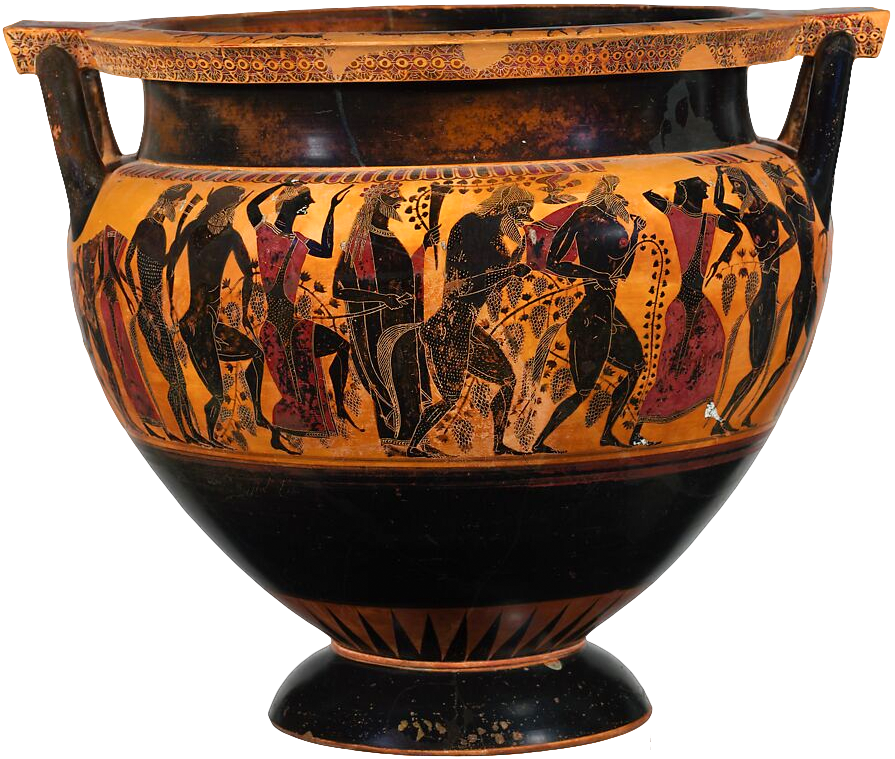
Before arriving, one would bathe; things typically got started around sundown. Upon arriving, slaves might wash your hands and feet, apply aromatic oils to your person, and provide you with a wreath woven from grape vines, this last in honor of Dionysus, god of wine. Festivities began with the dining phase, the deipnon.
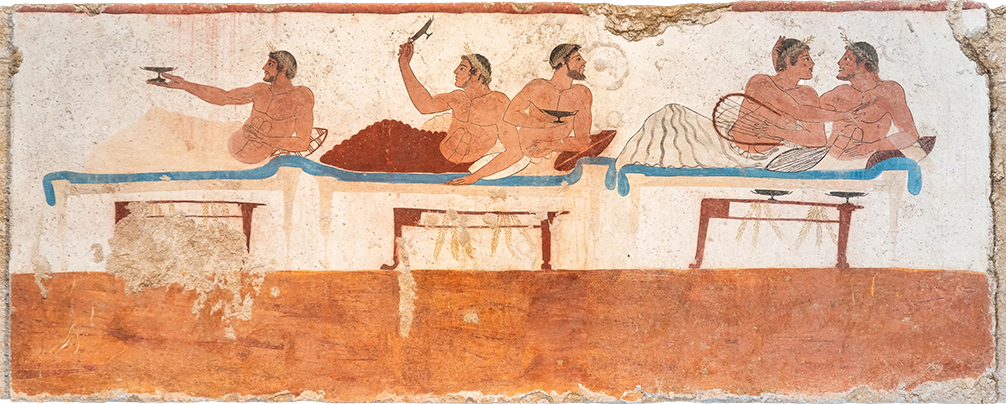
Then came the symposium proper, the drinking phase, during which one was to get pleasantly inebriated, not disgustingly drunk, though it didn't always work out that way. The wine was drunk mixed with water; the (male) guests reclined on couches during the festivities.
Guests might sing or recite poems, tell stories, or play drinking games like kottabos. Professional entertainers might be brought in: musicians, singers, dancers, etc. Performers might double as sex workers.
Later developments in the Roman East. Under the influence of the Roman convivium or cena, that is, the Roman version of the deipnon-symposium, respectable women started being invited as guests to the Greek versions of these affairs, just as, in the Roman East, women began to come into the foreground as public benefactors (see euergetism).
Particularly under the Empire, the symposium was a stage on which dramas involving class, status, and gender were repeatedly played out, as the Alcock reading ("Power Lunches in the Eastern Roman Empire") reveals.
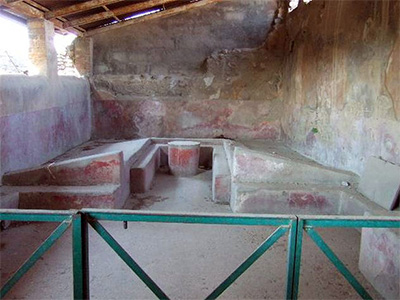
For the Roman convivium, and thus for Greek symposia influenced by Roman customs, the seating arrangements could be quite hierarchical. The word for a Roman dining room, and for the seating arrangements in it, was triclinium, meaning "three-couch arrangement." Ideally, an aristocratic Roman banquet involved nine diners arranged on three couches, three to a couch. Stretched out on one's left side, one ate with one's right hand. The couches would form a kind of letter Pi (Π), with individual couches partly overlapping, and with tables in the center for food and so on. See the diagram below for seating and status.
Note that the guest of honor typically will have reclined on the lectus medius (Latin for "middle couch"), perhaps in the middle of that middle couch, and thus with a good view of the garden that often will have been just outside the door. The host will have reclined on the lectus imus the "lowest couch," and thus with a good view of the important guests.
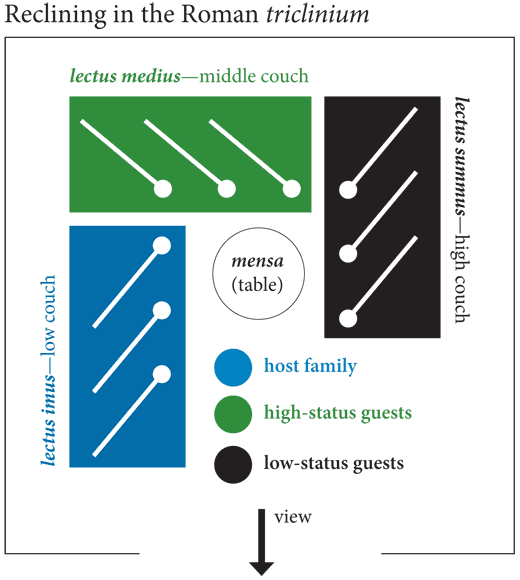
That number nine won't have been invariable. Among other things, weddings and the like will have involved many more guests and a more involved seating arrangement. Nor is it clear that Roman customs were always followed faithfully in Eastern houses, though clearly, they exercised an influence over the status-consciousness that seems to have been associated with with such affairs in that part of the world.
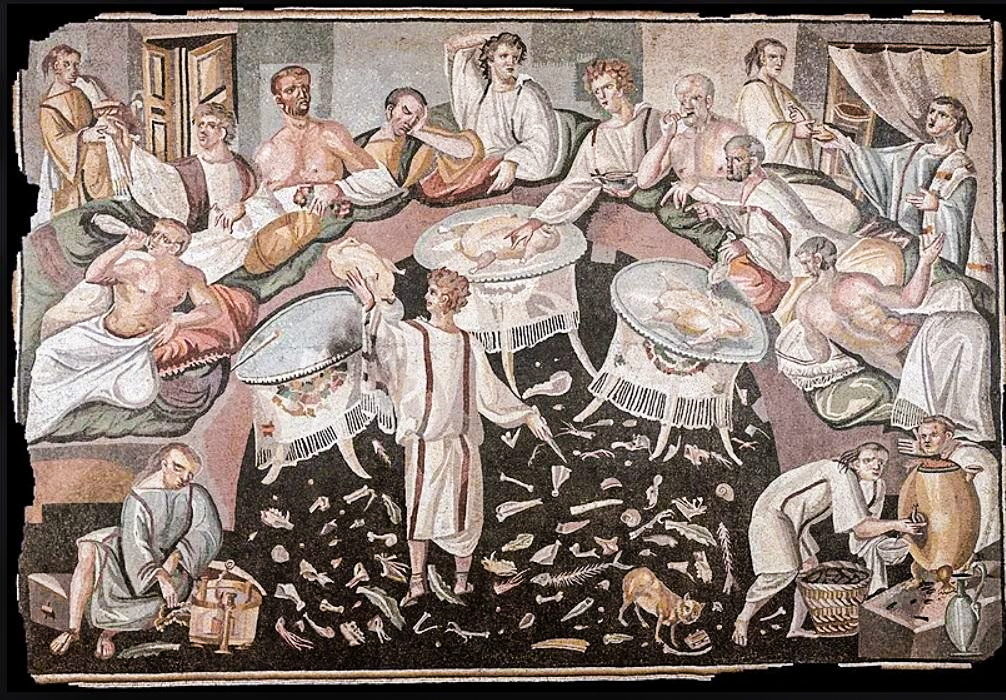
Nothing, though, stays the same, and evidence from the second century onwards suggests that couches began to be merged into a single, semi-circular structure referred to as a stibadium or a sigma (sigma because the letter sigma at this time was usually written as a semicircle, C; see image above). Dining while reclining, though it eventually died out in the west, seems to have persisted well into the middle ages in the Greek East.
As for what was eaten and other details, please refer to the Alcock and (for the next class) Lucian readings.