Be advised that the Lucian reading contains a brief reference to an attempted rape, also to urination.
Reading and Access
Thonemann, Peter. Symposium or the Lapiths. Cambridge, Mass. and London: Harvard University Press, 2026. 502–561. [online access]
SWA Prompt
The purpose of this SWA prompt is, again, to prepare you for the CT assessment of your FSS in paper 2. We're asking you to comment on the utility of the Alcock article assigned for last class, here, in relation to the Lucian primary text assigned for this class:
How useful is Alcock's "Power Lunches in the Eastern Roman Empire" as a guide to Lucian's Symposium, especially in regard to themes highlighted for the last assignment, namely, those of identity, status/class, and contest? What insights, if any, does the article yield in relation to the Lucian reading? Are there ways that Lucian poses challenges to Alcock's argument?
Lucian Symposium, or the Lapiths
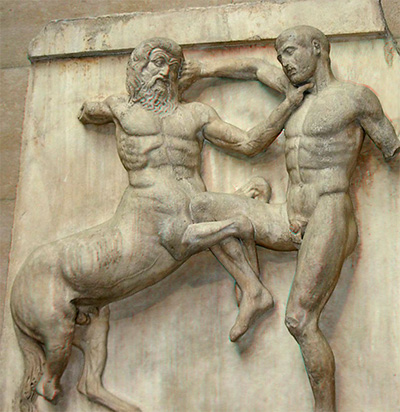
Thonemann's introduction to the dialogue (pp. 502-505 of the Loeb) is quite good and as such is recommended, but not required, reading.
Here, I'll try to cover what's necessary for our class.
The Greek manuscripts refer to the dialogue as (translating from the Greek) Symposium, or Lapiths. Whether or not Lucian or someone else came up with that title, it is apt. As a literary symposium, it recalls a number of works going as far back as Plato's Symposium, this last, a dinner-and-drinking party where the guests discourse on the nature of erōs, love.
As a raucous take on a wedding feast gone haywire, Lucian's Symposium recalls (and makes explicit reference to) the myth of the battle of Lapiths and centaurs. To summarize, the Lapiths were a mythical tribe in Thessaly, in the north of Greece. Among the guests at the wedding of Perithous, the Lapith king, and Hippodamia were centaurs, creatures half-horse and half-human, notorious for wildness and savagery. Unused to wine, they got very drunk and tried to make of with the Lapith boys and girls, bride included. In the battle that ensued, some centaurs were killed; the rest were driven away.
Something like that occurs at the wedding feast/symposium that Lucian dramatizes in his Symposium. Only these "centaurs" are intellectuals: philosophers, mostly, though a school teacher (grammatikos), a rhetoric teacher (rhētōr), and a physician are present as well.
A key consideration is the close relationship of this dialogue to "classic" dialogues of Plato (ca. 426–348/7 BCE) and Xenophon (ca. 430- 354 BCE), both of whom left behind works entitled Symposium. Indeed, many such works were written and read in antiquity. But the relationship to Plato is particularly close, especially the way that one speaker, Philo, presses the other speaker, Lycinus to recall for him an earlier event. That echoes Plato's Symposium and Phaedrus, both of which treat love, erōs, just as this one does — sort of.
It will help to say just a little about various characters involved; note that the philosophical schools to which the philosophers belong have a lot to do with Lucian's satire.
So, characters:
- Speakers of the dialogue:
- Lycinus (lie-SEE-nus), Lucian the author's fictional alter ego, and narrator of the event
- Philo, Lycinus' interlocutor
- Attendees at the wedding reception that Lycinus narrates:
- Aristaenetus (a-rist-aee-NEE-tus), father of the bride and host of the party
- Cleanthis (klee-AN-this), the bride
- Philosophers and other intellectuals:
- Zeno (ZEE-no), brother of the bride
- Diphilus (DIH-fi-lus), a stoic philosopher and Zeno's teacher
- Zenothemis (zee-NO-theh-mis), also a Stoic
- Stoics famously distinguished between the things that really mattered, virtue and such, and what supposedly didn't, namely wealth, fame, and all the rest, what they called "indifferent things.")
- Cleodemos (klee-oh-DEE-mus) the Peripatetic (i.e., a follower of Aristotle's philosophy)
- Hermon the Epicurean
- Epicureans believed true pleasure came from avoiding stress and pain; they also discouraged worship of the gods — stressful! Stoics and Epicureans, who upheld doctrines that partly agreed but largely disagreed, competed for followers.
- Histiaeus the grammatikos ("grammarian," the "language-literature teacher")
- Ion the Platonist
- Ion's student Chaereas, who is also the bridegroom
- Eucritus (YOU-kri-tus), father of the groom and someone also interested in philosophy
- Dionysodorus (dye-o-ny-so-DOR-us) the rhētōr (professional orator and rhetoric teacher)
- Dionicus (dye-o-NĪ-kus) the physician
- Hetoemocles (he-TEE-mo-klees), another stoic philosopher, also Aristaenetus' neighbor. Not invited, he isn't present himself but sends along a message
- Alcidamas (al-SI-da-mas) the Cynic, who bursts in uninvited
- Cynics believed that in all things we must act like dogs, hence the name, from kuōn, "dog." They attacked wealth, power, etc. as vanity, and sought to live simply. Diogenes the Cynic was reputed to behave shamelessly in public as a matter of principle.
- Servants, a jester, etc.
Notes
Notes keyed into page numbers of the Loeb text. Note that the Loeb has clickable notes that are very useful and, on the whole, user-friendly.
509. "the god who has never, so far as I know, left anyone uninitiated as a bacchant in his mystic rites" — Dionysus, god of wine.
515. "It was now time to recline for dinner" — when you dined socially, you would lay down on your side on a couch.
517. "dedicated to culture" — to paideia.
519. "how much food [Zenothemis is] giving to the slave standing behind him, imagining that no one will notice" — Z's slave, and the food, stuff to take home with him (cf. p. 547).
519. "noisiest of all the "dogs' " — i.e., of the cynics.
523. "Cleodemus gave his [the slave boy's] finger a squeeze and passed him, I reckon, two drachms along with the bowl" — Cleodemus is trying to bribe the slave boy into providing him, Cleodemus, with sexual favors. "two drachms" — well, a bit fussy to spell it that way. I'd have written, "two drachmas" (DRAK-muhz). How much was that? Without doing a lot of research, not nothing for the time and place in question, maybe payment for two days of labor, minimum wage. Slipped him a fifty? A Benjie? The bowl: The bowl is described as a phialē, a cup for intentionally spilling a certain quantity of wine on the floor or gound, that as an offering to the gods. I imagine that that is what Cleodemus and other guests are being invited to do with this cup. Did they also drink from the cup as if from a loving cup, that is, to the health of the assembled company? Quite possibly: In Lucian's Gallus, that happens.
525. "I drink to you, Cleanthis, in the name of Heracles, my patron." Alcidamas the cynic says this because Heracles, who, according to the cynics, cultivated strength, endurance, and so on, was regarded by the cynics as the perfect cynic. The fact that Heracles had kidnapped Cerberus, the dog of the underworld, sort of clinched the deal. The name "Alcidamas" recalls "Alcides," one of the names of Heracles.
525. "and as he spoke he bared even more of his body, to a truly shameful extent" — Alcidamas reveals his privates.
529. "Alcidamas flew into a rage (and it had long been obvious that he envied the jester's success and the way he was holding the symposium’s attention), threw off his cloak, and challenged him to a no-holds-barred wrestling match" — "he envied," the Greek is a verb form of the noun phthonos, "envy." "wrestling match" — literally, a pankration match, Greek mixed martial arts. The point isn't just the violence; it's the competitiveness between a jester and a philosopher, and how that reflects on the philosopher.
529. "Finally, since he was in serious danger, Dionicus devised the following plan. He challenged him to a contest, with a stated number of blows as the penalty." "Contest" = agōn; this will be a contest of pipe-playing .
531-537. Hetoemocles, a stoic, shouldn't care about not being invited. His message says otherwise. He also hints at an affair that the host's son Zeno is having with his teacher, Diphilus. Hetoemocles is also angry that Diphilus has poached students from him.
549. "fish cooked in a tagine" — in a frying pan.
549. "Best of all would be to have no need of marriage, but to follow Plato and Socrates and practice pederasty" — neither Plato nor Socrates anywhere says not to get married, get a boyfriend instead. Still, in Plato's Symposium and Phaedrus, pederasty, the quasi-ritualistic sexual courtship of a younger man/teenager by an older man, offers the model for intellectual and spiritual enlightenment.
551. "But if marriage with women is necessary, then, in accordance with Plato’s doctrines, we ought to have our wives in common, so that we might be without envy." In Plato's Republic, a book describing a hypothetical utopia, the leadership class is to practice wife sharing, one stated purpose of which is to foster friendship among leaders (423e-424a, 457c-d; cf. "The things of friends are in common," Greek proverb). Ion, not incorrectly, understands that as having the purpose of avoiding dysfunctional competition. He uses, though, a word, zēlos, that, at least for the time and place that concern us (the Roman East, 2nd cent CE), ordinarily means "emulation," "competitive striving," specifically, of a socially approved character. The usual word for malicious, antisocial competitiveness would have been zēlotupia ("jealousy") or phthonos ("envy"). Dionysodorus, in criticizing Ion for the supposed error, recalls how Lucian himself, ever keen on proving his Hellenic bona fides, was hypersensitive about linguistic mistakes (see The Mistaken Critic, where L. savages a sophist who criticizes his vocabulary; also, On a Slip of the Tongue in Salutation, where L. apologizes for using an incorrect morning greeting).
551-552. The poem Histiaeus recites is supposed to be terrible.
559. "Alcidamas was caught stripping the flute girl naked and trying to rape her by force." Shocking and upsetting by any measure, but meant to shock all the more to the extent that it reveals the philosopher's hypocrisy and lack of virtue.
Quiz 2
At the beginning of class there will be a VERY SHORT QUIZ on material covered in assignments, lectures, and discussions from 25-Mar (encomium) through and including 29-Apr (Lucian Symposium, this class).
The quiz will be very short, very plain, very non-interpretive and straightforward — a "fact-check" quiz more than anything.
Specifically, expect multiple choice questions targeting. . .
- Class-assigned readings, for which know. . .
- Authors (for instance, "Daphnis and Chloe was written by ____")
- Titles (for instance, "Longus wrote _____")
- Characters, key actors/speakers, where appropriate (for instance, "Daphnis' steady girlfriend is _____")
- Basic and crucial content info (for instance, "Daphnis and Chloe live on the island of _____")
- Key terms and concepts listed below, for which consult
- Your notes
- Our target texts
- The Terms page
- My PowerPoints
Review Terms List.
For definitions, see the Terms page. But please also review assigned readings, which this list does not necessarily address. For proper names, consult readings, study guides, PowerPoints, your notes.
- deipnon
- encomium
- epideictic
- euergetism
- figured rhetoric
- grammatikos
- hetaira
- liturgies
- parasite
- physiognomy
- sociality
- stibadium
- symposium
- triclinium