Assigned Pages, Text Access
Think of this as a continuation of the previous assignment, only here, we're focusing on declamation. Whether or not Philostratus is right to treat declamation as the central practice of Imperial sophistic, its place within sophistic performance practice and education demands attention.
To that end, we're reading and analyzing all of Lucian's very brief Tyrannicide ("tyrant killer"), pp. 445-473 (14 pages of English translation), from the following Loeb volume:
Harmon, A. M. Lucian. Volume V. London: William Heinemann, 1936.
SWA Prompt
In Lucian's Tyrannicide, does the imaginary speaker make a convincing case? Is the declaimer's (Lucian's) word-portrait (ēthopoiia, "characterization") of the imaginary speaker convincing? What do you think Lucian is trying to achieve with this speech?
Naturally, don't just supply brief answers, explain your answers.
Introduction to Reading
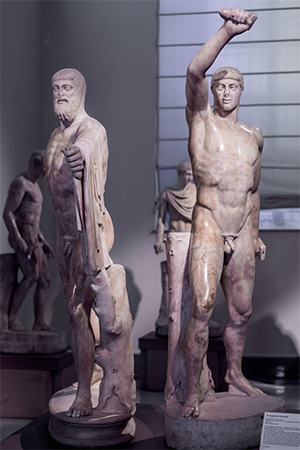
Our author is Lucian, whom we have met previously. As for the reading itself, Lucian's Tyrannicide ("tyrant slayer") purports to be a courtroom speech spoken by an unnamed speaker seeking to claim a reward for having slain a tyrant, that is, a ruler who has taken over a city by force and rules it despotically. Or rather, Lucian's speaker claims to have slain two tyrants for double the reward. We're not told which city this is, but it's a democracy recalling Athens during the classical period (400s-300s BCE). As for the imaginary speaker's claim, he bases it on a law rewarding tyrant slayers like himself. He doesn't quote the law, but we know that similar legislation, dating from 337/6, existed in Athens. Still, this last only guarantees immunity to tyrant-slayers; it doesn't reward them. Another reality evoked by the piece is dokimasia, a legal procedure whereby a plaintiff sought to challenge someone else's claim to something: citizenship, public assistance, some other right or privilege. Or, as in this case, someone's right to a reward.
What about the genre of such speeches in terms of their being imaginary? That genre is declamation. What is declamation? The following may help:
Declamation, in Greek, meletē (Latin declamatio), was central to the practice of specialists known, then as now, as "sophists" (Greek, sophistai), elite orator-teachers who flourished in the Roman East under the High and Late Empire. As a kind of rhetorical role-play, declamation was always a double performance. On the one hand, there was the dramatized speaker — a historical personage, a figure from myth, a character invented for the occasion — seeking to sway the judgment or opinions of the notional audience. On the other hand, there was the real-life author-performer of the piece, sometimes a student, sometimes that student's teacher, whose role-play was meant to demonstrate mastery of rhetoric in all its facets. (A. Scholtz American Journal of Philology 147.1 2026)
These declamations always involved role-play. Imagine that you are George Washington as a child. You must deliver a speech apologizing for cutting down the proverbial cherry tree. ("Father, I cannot tell a lie.") But you must also make the case, ever so discretely, that your frankness and contrition deserve your father's admiration. That's your hupothesis, your theme. Now go deliver that speech!
Declamations may have been show pieces, but they always posed as real speeches. As such, they usually took one of two, basic forms:
- A legal speech, with the declaimer (the real-life composer-performer of the piece) posing as prosecutor or defendant in a court case — or something similar
- A deliberative, usually political, speech, with the imaginary speaker either proposing policy or attacking it
We need to keep in mind the educational role of sophistic generally and of declamation in particular. Declamation wasn't just for superstar orators to perform. It was the crowning stage of the rhetorical education that many elite young (mostly) men undertook from maybe the age of 14 to about the age of 18 or later. Sophists therefore taught, and a sophist's collection of written-down declamations could/would serve as, among other things, examples to be studied by their students.*
* Study with a sophist would have been preceded by study with a grammar-school teacher, a grammatikos. Those studies were hardly basic, as they involved an arduous journey through Attic Greek: reading it (no piece of cake, as editions lacked lowercase letters, punctuation, word division), writing it (we're talking about what for most will have been a foreign language, or something close), and speaking it (there seems to have been an effort to preserve elements of archaic pronunciation). Study of the "classics" — Homer, tragedy, Plato, etc. — lay at the heart of this stage of study. Students will then have transitioned to the study of rhetoric, often under a grammatikos teaching in tandem with a rhētōr. After working their way through a series of increasingly challenging exercises, the most committed of rhetoric students will have graduated to the crowning stage of the curriculum: the creation and performance of declamations. At this stage, the sophist running the school and overseeing a staff of grammatikoi and rhētōres will, in many cases, have taken over. All throughout, though, the student never will have ceased studying classic literature, except now it's largely orators past, present, and in between who populate a student's reading list. The aforementioned is only a general pattern; the actual experiences of students and teachers could vary.
Returning to the theme of sophistic as performance, the venue for these performances could be a political meeting space, a theater or recital hall (theatron, ōideion), a marketplace (agora), even a temple. (A. Caruso in What's new in Roman Greece, 2015.) There, the sophist might, after the warm-up phase of the performance, might deliver a single, stand-along meletē or possibly paired meletai, thereby taking both sides, one after the other, in an imaginary dispute. And imaginary these speeches always were, sometimes extremely so. (More on what would have been on the program on the "Second Sophistic: Introduction" study guide.) From what we read in Philostratus, the soul of declamation was the creation of believable characters, or ēthopoiia, "characterization." But declamation also offered practice, and demonstrated skill, in zeroing in on the crux of the matter, its stasis or issue. Stasis theory offered a kind of algorithm for generating arguments well suited to the case one would need to make, given the issue at hand. I suspect that Lucian's Tyrannicide is meant to show skill both with arguments and with delineating character.
Notes (keyed to page numbers) on the Text
445. "Aman [i.e., a man] went to the Acropolis to slay the tyrant" etc. This bit at the beginning is the hupothesis. It briefly describes the situation on the basis of which the declaimer must compose a fully worked-out speech. It's not actually part of the speech itself.
445. "gentlemen of the jury," andres dikastai. Gender issues: juries, whether fictitious or real, were staffed by men, not women."
445. "the Acropolis." We can understand that as the Athenian Acropolis, the city's religious nerve center, or maybe just as a generic acropolis. In any case, this declamation, like so many others, is set in an imaginary time that resembles the period of Athens' greatness (400s to 300s BCE) or possibly just before that. The situation recalls, but differs from, events in Athens in 514 BCE, namely, the slaying of Hipparchus, brother of the tyrant Hippias. Bottom line: this is an imaginary case.
447. "My adversary here." Keep in mind that this is a case where someone challenges the speaker's right to the reward that he claims. The speaker's legal opponent may wish to wreak vengeance on the speaker for the deaths of the two deceased persons (so the speaker claims), but the procedure in question (dokimasia) only contests the speaker's right to a reward.
449. "tyrannised." Yes, that's a play on words, even in the original. The Greek uses eturanneito, from turannos, "tyrant."
449. "It was he who kept their guardsmen together." The power of tyrants in ancient Greece stemmed from the personal guard or militia that tyrants could rely on to terrorize the people.
451. "for when the desires of the will acquire the license of sovereignty, they recognise no limit to wrongdoing." This is the classic idea of the tyrant as a ruler whose power gives free reign to the tyrant's desires.
451. "front." Annoying to have to use older translations. "Front" here = "confront."
453. "supplied the ending to my play." Lucian in Slander similarly speaks of slander as a drama, a "play," nor is that the only other instance of comparing events to theater. We can maybe think of these actions as performed according to script, and always before some sort of audience.
455. "What more do you demand of me?" This speech is replete with questions, most of them, "rhetorical" questions. How might these rhetorical questions argue the imaginary speaker's case?
455. So, why might someone argue that the speaker is not, in fact, a tyrant-slayer?
455. "guerdon," Greek gerōs. Reward.
469. "Good sword, partner and promoter of my successes, after so many perils, after so many slayings, we are disregarded and thought unworthy of a reward!" He's talking to his sword as if to his partner in the deed. The rhetorical figure is apostrophē.
469-70. "Before I slipped away, I had myself composed ("I had become the poiētēs, the 'author' of") the | whole plot of the tragedy (tragōidia), but had left to the actor (hupokritēs) the body, the stage-setting (skēnē), the sword, and the remainder of the play (drama)."
471. "A little while ago" — here, the imaginary speaker quotes the speech that he supposes the grieving father to have uttered.
473. "the blood of both intermingled (that thank-offering for liberty and for victory)." The imaginary speaker represents the shed blood of father and son as a libation, a drink offering, to the gods in thanks for the return of freedom."
Quiz 1
At the beginning of class there will be a VERY SHORT QUIZ on material covered in assignments, lectures, and discussions from 21-Jan (Introduction to class) through and including 23-Feb (this class meeting).
- The Swain reading (4-Feb) will be covered. The 9-Feb (Library session) will NOT.
The quiz will be very short, very plain, very non-interpretive and straightforward — a "fact-check" quiz more than anything.
Specifically, expect multiple choice questions targeting. . .
- Class-assigned readings, for which know. . .
- Authors ("Daphnis and Chloe was written by ____")
- Titles ("Longus wrote _____")
- Characters, key actors/speakers, where appropriate ("Daphnis' steady girfriend is _____")
- Basic and crucial content info ("Daphnis and Chloe live on the island of _____")
- Key terms and concepts listed below, for which consult
- Your notes
- Our target texts
- The Terms page
- My PowerPoints
Review Terms List.
For definitions, see the Terms page. But please also review assigned readings, which this list does not necessarily address. For proper names, consult readings, study guides, PowerPoints, your notes.
- agōn, agonism
- declamation
- erōs
- ēthopoiia
- meletē
- paideia
- philotimia
- phthonos
- second sophistic
- sophist
- sophistic
- zēlos