This isn't very much reading. It will, though, require close attention and good note-taking, especially since the assignment offers us a chance to get ready for the upcoming Oral Presentations 2, which will ask you to exercise your skill at two things:
- Encomium, a "praise speech," where the subject of praise is also your addressee.
- Figured rhetoric, generally understood as speech with a (semi-)hidden agenda agenda, this last often taking the form of advice or admonishment — semi-hidden because it needs to do the trick without drawing attention to itself.
SWA Prompt
In preparation for the upcoming Second Oral Presentations (OP2s), this class meeting is mostly going to be devoted to work-shopping a rough draft for an encomium praising ("praising"?) the tyrannicide ("tyrant killer") from Lucian's speech of that name. So, for your SWA, I want you
- To study this Study Guide and readings accessed from it
- To review, as need be,
- Lucian's tyrannicide speech with Study Guide
- Dio of Prusa's Oration 29. (As a funeral oration, it is, in effect, an encomium)
- If you've read the above already, a full-on re-reading probably won't be necessary. If you haven't yet, read them now!
- To assemble a numbered list of talking points for a speech couching advice/admonishment as praise. How many talking talking points? Use your judgment, though keep it within the usual recommended word count for SWAs
- When assembling your talking points, make sure to think of how to use #1 above (encomium = praise) as a delivery mechanism for #2 (figured rhetoric = advice/admonishment). Maybe you covertly support tyranny. How do you attack this tyrannicide's actions without seeming to? Make sure as well to state explicitly what your hidden agenda is.
Readings and Access
Study carefully:
- This Study Guide, including the passage, quoted below, from Philostratus' Lives of the Sophists
- The Encomium section of the Oral Presentations page
- Burton Silva Rhetoricae, the brief entry on encomium
- Menander Rhetor Treatise 1
- pp. 21-25 (introduction, on epideictic genre more generally)
- pp. 195-209 (on "talks," laliai, a shorter, more informal type of oration, though one that can be used for encomiastic purposes). Note discussion of
- How, by comparing the honoree to mythological and/or historical personages, the orator adds "sweetness" to the speech
- Similar use of (made up) dreams
- Captatio benevolentiae. Menander writes in Greek, so he doesn't use this Latin phrase, though we will. CB refers to rhetorical strategies for currying favor with one's audience (p. 201 sect. 9). In a more extended sense, we can use it to refer to the process of insulating oneself against criticism or disapproval (p. 203 sect. 11)
- Free but well planned arrangement (". . . one must aim for the right moment to make each point and understand what is advantageous to put first and what second")
- Length (p. 209 sect. 22)
- Pseudo-Dionysius Art of Rhetoric, "How to Compose Addresses," pp. 407-415 Loeb. Useful for its discussion of the topics of praise speeches (encomia)
- Demetrius On Style, sect. 287-296, pp. 509-517 Loeb, on "allusive verbal innuendo," to eskhēmatismenon, what we're calling "figured rhetoric"
Philostratus on figured rhetoric
The following comes from Philostratus' Lives of the Sophists, specifically, from the Life of Herodes Atticus (pp. 209- Loeb). Summoned to go on trial before the emperor Marcus Aurelius at Sirmium, a military outpost in what is now Serbia (the year is 174 CE, or thereabouts), Herodes stood accused by his enemies, the Quintilii, and by the Athenians, of tyrannical behavior towards Athens and its people. (We're told that, in the end, Marcus decided for the Athenians, but imposed a mild punishment.) For reasons not made fully clear, Herodes brought with him two girls, servants of his, of whom we're told he was very fond:
. . . Herodes lodged in a suburb in which towers had been built and half-towers, and there had traveled with him from home twin girls, who were just at the age of marriage and were astonishing in their beauty. Herodes had raised them from infancy and appointed them his cupbearers and cooks, and he used to call them his little daughters and embraced them as though they were. These girls were in fact the daughters of Alcimedon, who was a freedman of Herodes. While they were sleeping in one of the towers, which was strongly built, a thunderbolt fell upon it during the night and killed them.
Herodes was driven out of his mind by this grief and went before the emperor's tribunal when he was irrational and in love with death. When he came forward to speak he launched into invective against the emperor and did not even bother to shape his speech into rhetorical figures,* though one would expect a man who had been trained in such a style of speaking would manage his own anger. But with an aggressive and unadorned tongue he persisted in the attack: "This is what I get for showing hospitality to Lucius, whom you sent to me. On these grounds you judge me, to please a woman and a three-year-old child."** When Bassaeus, the praetorian prefect, said this would be the death of him, Herodes said, "My good fellow, an old man fears few things."
So Herodes went away from the court when he had said this and left a lot of water in the water clock.† Let us consider Marcus' conduct in this trial among the most outstanding examples of his philosophical practice. For he did not draw together his eyebrows, nor did he alter the expression of his eyes, which might happen even to a mere magistrate, but turning to the Athenians he said, "Make your defense, Athenians, even if Herodes does not give you leave."
* oude skhēmatisas ton logon, "without recourse to figured rhetoric," on which more, below.
** Lucius Verus was the adoptive brother of Marcus Aurelius and co-emperor with him. Marcus was suspicious of Lucius. It is not known to whom the quotation referes when it speaks of "a woman and a three-year-old child." Papalas Aevum 1979 p. 90 argues that "the empress Faustina [Marcus' wife] and her daughter [Aurelia Sabina]" are meant. See also Karambelas in Ιουλίαν Βελισσαροπούλου 2020 p. 382.
† At a trial a speaker had only limited time to speak. The timing mechanism was a water clock. Herodes had plenty of time to make a better speech.
Epideictic Genre: Historical Overview
Encomium, "celebratory" or "praise speech," is generally understood to be a species of epideictic. What is epideictic? Read on. . . .
Classical Athens (400s-300s BCE)
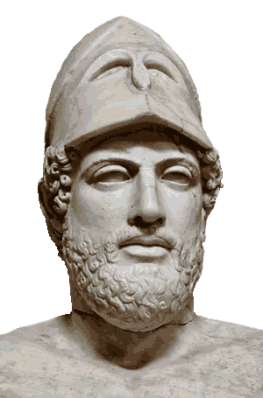
Our earliest epideictic speech dates from the 400s BCE. It is a funeral oration (epitaphios logos) honoring fighters killed in war, specifically, the one that the historian Thucydides puts in the mouth of Pericles (494-429 BCE), leader of the Athenian democracy during its golden period.
But the theorizing of epideictic (of which funeral oration is a sub-genre) had to wait until Aristotle (384-322 BCE), whose Rhetoric, the first surviving treatise on the subject, famously divides rhētorikē into three basic types:
"The kinds of Rhetoric are three in number, corresponding to the three kinds of hearers. For every speech is composed of three parts: the speaker, the subject of which he treats, and the person to whom it is addressed, I mean the hearer, to whom the end or object of the speech refers. Now the hearer must necessarily be either a mere spectator or a judge, and a judge either of things past or of things to come. For instance, a member of the general assembly is a judge of things to come; the dicast [juror], of things past; the mere spectator, of the ability of the speaker. Therefore there are necessarily three kinds of rhetorical speeches, deliberative (aka political or symbouleutic), forensic (aka legal), and epideictic.
"The deliberative kind is either hortatory or dissuasive; for both those who give advice in private and those who speak in the assembly invariably either exhort or dissuade. The forensic kind is either accusatory or defensive; for litigants must necessarily either accuse or defend. The epideictic kind has for its subject praise or blame."
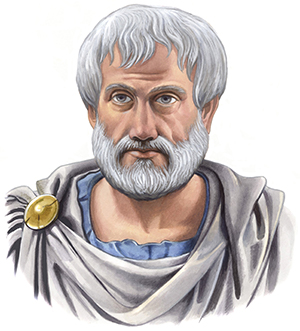
The upshot is that, at least for Aristotle, those divisions are largely about the role of the audience, the "person to whom it [a speech] is addressed." Thus, what sets epideictic apart is that its audience, unlike audiences for courtroom or political speeches, is there most of all to judge a speaker's skill, which rather assimilates audience members to spectators. That makes epideictic into a kind of "show," with the orator as star performer, which is to say, as the one "showing off" (epideiknusthai). "Epideictic" means, in fact, "for show," and the proper focus for such speeches is, according to Aristotle, praise or blame, not, as with other genres, giving advice, as in political speeches, or procuring a particular verdict, as in courtroom speeches.
Later, especially Imperial Greek, Epideictic
But that's not the end of our story. In time, the practice speech or meletē, a term often translated as "declamation," would break out of the confines of the classroom into the public arena. Indeed, by the beginning of the second sophistic (first through third centuries CE), meletē, though it never shed its pedagogical role, had blossomed into performance art for its own sake. As performance art, meletē was inherently "epideictic," that is, concerned with showing off the rhētōr's skill, no matter the supposed genre of the speech, which, as we have seen, could pose as a legal pleading or as a political intervention. But meletai, in addition to displaying the orator's skill or sophia, also put paideia on display — paideia in the sense of cultural literacy. All this was done at least in part for the winning of prestige. Any act of giving a speech in public could be understood as contest (agōn) and as demonstration (epideixis).
Rhetoric did not, however, cease to hold practical value. Whether in city assemblies or in the courtroom, speakers needed to know how to speak. Still other speech occasions were decidedly of an epideictic character (in the narrow sense of "epideictic"). Thus we have orations praising people or things (encomia, sometimes called panegyrics), funeral orations (epitaphioi), orations of welcome or farewell for an important personage (epibatēria, propemptikai), and so on.
Consider the case of a speech addressing an emperor. There, the orator had to share the limelight with someone whose feathers, if ruffled rather than skillfully and judiciously stroked, could do you serious harm. But there was another function that any speech performed before a ruler, especially any speech praising that ruler, performed: that of currying favor with a view to obtaining special concessions or benefits, for oneself or for one's city. Nor was that all. Even if the chief function of rhetoric addressed to emperors was to praise them, the orator might still work in stealthily camouflaged meanings: criticisms or advice couched as subtext or double-speak. Which brings us to our next topic. . .
Figured Rhetoric (eskhēmatismenos logos)
Eskhēmatismenos logos, or "figured rhetoric," is the art of striking a pose (schēma) or acting the part (hupokrisis) of someone seemingly not saying something that you're saying. Put differently, it's speech that seeks to get across something you want your audience to hear and to heed, though without their noticing, especially when noticing would offend or alienate them. As such, it can be broken down into two, broadly overlapping categories:
- Argument by bluff. Similar to what's sometimes called reverse psychology, it's a way to argue for something counterintuitive, maybe a little crazy, all the while dropping hints about the thing you actually want your audience to do, the idea being that they'll take the hint and opt for the less crazy thing. Say, for example, you don't want your fellow generals, eager to go to war, to do so. You can use figured rhetoric to seem to argue in favor of the war, affirming that victory will bring all the greater glory, given the odds stacked against your side ("history will long remember your dauntless daring, whatever the outcome"), not to mention the price-tag of the war ("forces never before seen will be mobilized; that alone will earn glory well worth the incalculable cost"). Criticize prudence as a lack of vision, but don't fail to mention that prudence, however boring, will assure success.
- Argument by flattery. This is a way to speak to power when being direct would risk failure, disfavor, or worse. Make sure to praise your addressee, whether an emperor, a governor, or whatever, amply. Remember especially to attribute to your addressee the sorts of qualities and/or actions that you feel they should possess and/or display, whether they actually do or don't. Make the case for those qualities/actions in such a way that your addressee would, for whatever reason, regret not to possess/display them.
Of course, figured rhetoric can be both 1. and 2., above, at the same time. In any case, the chief technique deployed by all figured rhetoric is that of speaking kat' emphasin, "by innuendo." This last can be explained as the art of advancing agenda X without drawing attention to the fact that X is on the agenda — the art of hinting, suggesting, not overtly saying.
Lastly, in talking about figured rhetoric, I'm tempted to speak of hidden agendas, but it can't really work if the agenda is hidden so well that no one notices; hence my formulation "(semi-)hidden agenda." On the other hand, should an emperor, a judge, indeed, anyone in power call the speaker's bluff, that could bode poorly for the speaker — so be careful!
Brief Notes: Authors and Works
I don't have much to say about our ancient authors, partly because, with one exception, very little is know about them. As for Menander Rhetor, the author of what the Loeb translation calls Treatise One (two are preserved under under Menander's name), I will only echo the Loeb: that the author may have come from Anatolia, perhaps southwest Anatolia (an ancient authority makes Laodicea on the Lycus out to be his native city), and that he likely dates to the late 200s, perhaps to the reign of Diocletian. Both treatises attributed to Menander deal with epideictic rhetoric; what I'm having you read provides an overview of epideictic genre as it was understood in our period.
Pseudo-Dionysius is called "pseudo-" because, though the rhetorical treatise from which you're reading is attributed to Dionysius of Halicarnassus, it clearly isn't by DofH. The Loeb editor-translator dates the treatise to the mid or late third century CE. For us it is useful because it provides guidance as to the topics of praise speeches.
The treatise preserved under the title On Style, and attributed to one Demetrius (whether or not that actually was the author's name), is probably earlier than our period and may date to as early as the second century BCE. The section I've assigned is important because it covers the other topic for today, figured rhetoric.